
Shubala y Madan
Traducción del inglés por Juan C. Perdomo Morales
Texto original de Cornelia Sorabji
Edición por Laura Rodríguez-Mejía
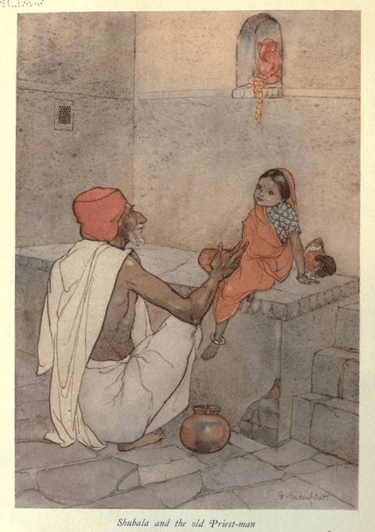
Imagen: Shubala and the old Priest-man, ilustración de Warwick Goble, 1920.
La primera vez que vi a Shubala, tenía seis años, era un bultito regordete y risueño, envuelto en metros de un sari rojo amplísimo para ella. Jugaba como receptora de críquet con su hermano Madan Mohun, de ocho años.
Era un espectáculo encantador ver aquel partido de críquet. Madan y Shubala, junto con el tutor bengalí de Madan (cuyo único conocimiento del juego era el de espectador esporádico en el maidan de Calcuta), jugaban juntos en la más deliciosa confusión posible, tanto de jugadores como de bandos, e igualmente confuso era su terreno de juego.
Jugaban sobre un montón de césped entre un templo en ruinas y los escalones de un ghat, mientras los sacerdotes, con sus toallas, se dirigían al agua cruzando la cancha en medio de las más emocionantes carreras. Al reprenderlos preocupada por la seguridad de aquellos hombres santos, Madan me respondió «¡Oh! No hay de qué preocuparse, la pelota sabe que es un sacerdote y no lo lastimará». El sacerdote, al escucharlo, lo tomó como un acto de respeto y siguió su camino observando semejante trío a su paso. Fue este mismo viejo sacerdote quien después le contó a Shubala tantas bellas historias de los dioses mientras ella estaba sentada bajo la imagen del Dios Sabio, el de cabeza de elefante.
De pequeños, los niños solo tuvieron otro entretenimiento. Jugaban con los dioses y la diosa patronos de su rajbari, que eran el Señor Jagannath, su hermano y su hermana; dioses con rostros humanos y ropas que cubrían su falta de piernas. Madan me contó una leyenda que explica esto: «El Escultor Divino era en realidad un guerrero, no un escultor, así que cuando sonaron las trompetas de la batalla, se apresuró y agarró su propio turbante, lo rasgó en tiras y lo arrojó sobre sus creaciones, ocultando el hecho de que su obra estaba inconclusa, partiendo de inmediato a la guerra».
Estos dioses son lo más parecido que muchos tienen a las muñecas en la infancia, por lo que no es de extrañar que Madan y mi Shubala, al encontrarlos en el cuarto de adoración (Puja Ghar), pidieran imitaciones para sus juegos. Después de recibirlos, los instalaron en un templo improvisado en el jardín, del tamaño de una casa de muñecas, hecho por ellos mismos con ladrillos y hojas de palma. Madan, quitándose la camisa y con el cuerpo y la frente cubiertos de ceniza, imitaba al viejo sacerdote mientras Shubala, con el rostro cubierto con su sari dejando solo entrever la punta de su traviesa nariz, llevaba guirnaldas de caléndula en sus manos «para hacer la puja», imitando a las mujeres que visitaban el templo del sacerdote al otro lado del camino.
Una vez encontré a Madan Mohun dibujando un retrato bastante realista de los Jagannath. Dibujé un caballo a su lado y le dije, «He aquí el caballo en el que tu guerrero-escultor cabalgó hacia la batalla». Aterrado, el niño casi cae sobre su templo de ladrillos y hojas de palma. «¿Vendrán caballos por mí?», preguntó con voz de asombro y los ojos bien abiertos. Luego, repitió lentamente, «¿Saldrá algo por mí… de este lápiz?».
Con mucha paciencia pude entender a lo que mi querido niño se refería. Poco antes, les había dicho a sus Jagannath, en pleno juego de puja, «Es preciso que los deje. Debo ir a mis lecciones. Pero vengan conmigo, siéntense dentro de mi lápiz». ¿No resulta entonces natural que él pensara que algo saldría de su lápiz? Debió haber creído incluso que saldrían de su propia mano. Qué mundo tan maravilloso, un mundo lleno de asombro y belleza.
Este fue el comienzo del conocimiento de los niños sobre muchas de las alegrías de la infancia, pero pronto las verdaderas figuras de juguete y los animales de carne y hueso reemplazaron a los Jagannath reservados solo para su adoración.
Siempre esperaba impaciente mi visita a ese rajbari en particular. Parte del camino lo recorría en tren, pero las emociones de la aventura salían a flor de piel solo cuando mi carruaje de fuego y vapor me dejaba en un lugar que en realidad no era ningún sitio, un paraje inhóspito entre campos verdes y vastas distancias lejanas, hasta que me topaba con una gran variedad de «transportadores de personas» expectantes a mi decisión.
Había un palki con una docena de porteadores, con el pecho descubierto y bien relucientes bajo el incesante calor; un viejo carro de bueyes sin resortes, en el que podía viajar mientras los porteadores llevaban mi equipaje colgado en cestas de cuerda, como cargando un par de garrafas de leche atados en los extremos de un largo palo, y un trío de elefantes, «El Amado Veloz», «El Amado de Ganda» y «La Perfección de la Belleza».
Esos eran sus nombres, según me dijo el mahout, pero incluso antes de oír sus deliciosas denominaciones, yo ya había decidido que solo los elefantes, y no ningún otro medio, serían los que me llevarían al bari.
Pronto descubrí que El Amado Veloz recibía su nombre como método educativo digno de elogio, para inducirlo a algún insignificante intento de movimiento. La Amada de Ganda, por su parte, era la viuda anciana de un tal Ganda, fallecido hacía mucho tiempo. Cuando encontraron a Ganda, su esposo, una criatura salvaje de los bosques de Sylhet, estaba de pie, cubriéndola con larguísimas guirnaldas de flores que arrancaba de las enredaderas florecientes hasta su cabeza. Así que inmediatamente fue nombrada «La Amada de Ganda», y llevó consigo al cautiverio el recuerdo de ese último día de esparcimiento y amor.
Cuando monté por primera vez a Perfección de la Belleza, solo tenía tres años y en más de una ocasión me deslicé por su lomo hasta caer por su cola durante el viaje por los campos y los caminos de la aldea. Había olvidado que el lomo de un elefante bebé se inclina repentinamente, pero siempre aterrizaba de pie, sin ningún daño, satisfecha porque su paso era casi el de un equino. Así, incluso con nuestros frecuentes reajustes, llegamos al bari una hora antes que Amada y Veloz.
Con el tiempo, Perfección desarrolló un lomo de lo más confiable, pero ahora hay un bebé de un año que me espera al bajar de la estación, corriendo alrededor de la señora Ganda, porque se niega a quedarse en casa cuando hay algún viaje programado. Esta criaturita, El Emperador Guerrero, me divierte enormemente con su balbuceo y sus montones de babas, con verlo chupar la trompa como un bebé humano chuparía su pulgar, y cómo se la ofrece a mi robusto Perfección para que él también la chupe.
Suelen ser alrededor de las cuatro de la mañana cuando monto mi elefante, cuando todo parece una gran niebla gris (o gris plateada, si ha sido una noche de luna tardía) y los campos, de un verde esmeralda, se extienden hasta fundirse en una mancha borrosa que, en la distancia, son las palmas y las chozas de una aldea, justo delante de una línea azul oscura, casi púrpura, que puedo divisar, que no es más que hilera de colinas a lo lejos. A menudo, vi también un reluciente arcoíris sobre la sombra distante, y nunca he sabido qué amo más, si el arcoíris o el color de la bruma del amanecer invernal, con nada más que un pálido rubor rosado como promesa.
Con las lluvias, llega la pesca, pues debemos tomar el camino más largo hasta el bari. Los puentes son arrastrados por el agua, y chapoteamos y atravesamos las inundaciones, de suerte que yo y el espacio del lomo de Perfección donde me siento son las únicas islas secas en toda la travesía.
Ganda llevaba el equipaje, y jamás podré entender porque ese peso mayor que el mío no es tan seguro sobre su lomo como lo soy yo sobre Perfección, pues con asidua frecuencia debí resignarme a ver cómo la cesta del almuerzo seguía a mi vestidor en su caída al agua color café-au-lait.
En esta época del año, la población, vestida con sombreros de estera y taparrabos, ara con sencillez el campo y siembra arroz con gran vigor, lo que cambió mis ideas sobre los apáticos ryot que, cuando no están arando o plantando el brillante arroz verde, pescan por montones. Suelen construir una rudimentaria esclusa que empoza agua dentro de límites manejables y luego, con cestas de estera colgadas con cuerdas, sacan el agua de la esclusa atrapando los peces en ellas o dejándolos en el barro para ser directamente recogidos con las manos.
A Madan Mohun y Shubala siempre les hacía mucha gracia ver como yo disfrutaba observando tal actividad. Ellos se acostumbraron a venir a mi encuentro, pues, en una ocasión, me alegró que mostraran esa cortesía con una amiga inglesa que llevé conmigo a visitar a mis amigos del bari a la orilla del río. «Debíamos mostrarle nuestra alegría por que haya venido», dijo la Rani. Así que algunos jinetes nos recibieron en el camino entre la estación y el bari, acompañándonos con gran estilo, mientras Madan y Shubala nos encontraron más cerca, casi llegando, como ya lo he dicho. Poco después, tras un breve descanso en nuestro pequeño campamento de tiendas, fuimos a ver a las ranis, y Rani-Ma tomó la mano de mi amiga y, sonriéndole, la llevó de un lado al otro por toda la azotea. «Aún no tenemos ningún lenguaje en común», dijo, «pero grande es mi deseo de que la Mem Sahib sepa que es bienvenida».
Con el tiempo, la Rani dijo: «Madan Mohun debe dejar este desolado lugar para ir a estudiar a una gran ciudad». Así que se despidieron de aquel paraje que devastaba el río cada año, y toda la familia, incluyendo a Rani, la abuela, Shubala, Madan Mohun, dos crías de leopardo, varios gatitos, algunos conejillos de indias, un perro amarillento y sarnoso, y un loro gris, se trasladaron juntos a la ciudad británica más cercana y se establecieron allí, en un bari alquilado, hasta que yo pudiera construirles una casa a su gusto.
El primer desastre ocurrió cuando uno de los leopardos rompió su jaula y Madan Mohun se salvó por suerte. Sin demora, entregamos los animales al zoológico, aunque Madan y Shubala lloraron amargamente.
Pero los niños tuvieron un doble consuelo, sus conejillos de indias se reprodujeron ferozmente (como es natural en los conejillos) y descubrieron las maravillas de las tiendas. De hecho, tuve que darle a estos dos pequeños, extravagantes y necios, una diminuta mesada para juguetes, con el fin de salvarlos a todos de la bancarrota. Aun así, la pequeña cuantía alcanzó para que Shubala tuviera una numerosa familia de muñecas. Primero, insistió hasta el cansancio al zenana-amla que le consiguiera unas porcelanas alemanas para una muñeca. Poco después pidió al padre, a la madre y a sus doce hijos, cada uno más pequeño que el anterior, a quienes acostaba juntos sobre un enorme takht-posh para evitar accidentes, mientras ella jugaba con los gatitos y las cobayas, a los que siempre amó por encima de todo.
Por su parte, Madan Mohun era un muy buen niño, algo gordo y muy franco, en muchos aspectos, bastante parecido a un colegial inglés, aunque, a diferencia de ellos, rara vez se metía en líos.
Recuerdo solo una ocasión en la que tuve que ser severa con él. Su madre lo envió conmigo para reprenderlo por un asunto menor, y hablamos del tema. Madan me hizo una promesa que, para mi pesar, rompió al poco tiempo.
Cuando su madre lo mandó de vuelta con el mensaje de que había incumplido su promesa, Madan me lo transmitió, pero astutamente agregó: «en el zenana no saben que si cruzas los dedos de las manos y de los pies mientras dices una promesa, entonces, deja de ser promesa». ¿Cierto que no la rompí? Sigo siendo todo un caballero, ¿verdad?
Mientras tanto, Shubala había crecido tanto que llegó el momento de casarla. La madre y la abuela se vistieron deliciosamente pintorescas al evaluar a los candidatos que pretendían desposarla. Finalmente, se hizo la elección y celebramos una gran boda, una combinación deslumbrante de costumbres ancestrales e invenciones modernas: procesiones de animales disecados y barcas de tamaño real, figuras cómicas de barro, iluminaciones eléctricas, y ¡hasta un automóvil decorado con flores para el flamante esposo!
Para mi alegría, cuando terminaron los festejos, Shubala volvió a ser una niña, aunque por poco tiempo. Pero la historia de la vida de Shubala casada se las contaré más adelante. Ahora vive en el interior del país y ya no puede jugar al críquet ni visitar al viejo sacerdote del templo de los elefantes, ni escuchar sus historias de los dioses.
Madan Mohun se compadece, hace lo que puede y se limita a recordar los buenos tiempos. Los avisos de su club deportivo están colgados en la pared exterior del zenana y permite que Shubala diseñe los uniformes de sus jugadores.
«Club Internacional de Fútbol», fue el anunció que leí en una ocasión. «Pese al mal tiempo, invitamos a los jugadores a distraerse», decía otro. Madan Mohun luego me explicó que, como fundador y presidente del Club, le correspondía distraer al equipo con dulces y entretenimiento los días en que la lluvia arruinaba los partidos.
—¿Pero por qué llamarlo ‘distracción’, Madan Mohun?¿No se divierten ya jugando?
—Porque jugar es un trabajo —, respondió sabiamente este bengalí convertido al evangelio británico del deporte.
Shubala y Madan
When I first saw Shubala, she was six years old, a fat little bundle of smiles and roundnesses bunched up in a bright red sari yards too roomy for her. She was keeping wicket for her brother Madan Mohun, aged eight.
It was a lovesome sight, that game of cricket. Madan and Shubala, and Madan’s Bengali tutor (whose acquaintance with the game had hitherto been that of a spectator on the Calcutta maidan), playing together in the most delicious confusion possible, of persons and of parties. Of like incongruity was the setting of the game.
They played on a strip of grass between a ruined temple and the steps of a bathing ghat: and the loin-girt priests made their way to the water, across the most thrilling of “runs”. When I remonstrated for the safety of the holy men, “Oh!” said Madan, “the ball knows it is a priest-man: it won’t hurt him.” And the priest-man acknowledged this deference by scouting for the trio as he passed. It was this same old priestman who told Shubala god-tales, as they sat below the image of the Wise One, the elephant-headed.
The children had only one other game. It was played with the patron gods and goddess of their rajbari. These were Juggernaut and his brother and sister—the gods with human busts, be-skirted, to cover their leglessness. Madan told me the legend which explains this: “The divine carver was really a warrior not a carver, so, when the trumpet sounded for battle, he hastily seized his own turban, and tore it into strips, to make the petticoats which hid the fact that his work was unfinished, and so he was able to go at once to the war.”
These gods are likest of any to the dolls of childhood, and it was no wonder that Madan and my Shubala, finding them in the house of worship (the Puja Ghar), should beg duplicates for the house of play. These they installed in a garden temple the size of a dolls’ house, built by themselves of bricks and covered with palm leaves; and Madan would strip to the waist, smearing his body and forehead with ashes, in imitation of the old priest-man; and Shubala would pull her sari over her face showing only the tip of her saucy nose, and would bring wreaths of marigolds “to do puja” in imitation of the women who visited the priest-man’s temple across the way.
Once I found Madan Mohun drawing a most realistic picture of the Juggernauts. I drew him a horse. “And here,” I said, “is the horse on which your warrior-carver rode away to battle.”
The child almost sat down on his brickpalm-leaf temple in his astonishment. “Will horses come for me?” he asked in a voice of awe, large-eyed. Then, slowly, “Will anything come for me—out of this pencil?”
And, with patience, I extracted the knowledge that the dear baby had said to the Juggernauts at his puja game, “It is of necessity that I now leave you for slate-pencil lessons; but come and sit inside my pencil.” And so—was it not only natural that their “form” miracles came on to his slate? But could other form-miracles come, even when you did not worship them? Could your own hand do it? It was a very wonderful world. Truly was it a world of wonder and of beauty.
This was the beginning of the children’s acquaintance with many of the joys of childhood; and toy-people, and flesh and blood animal-people, soon took the place of the Juggernauts reserved for worship.
I always looked forward to my visits to this particular rajbari. Only part of the road was travelled by rail; the excitements came when your “fire-carriage” dumped you down in a nowhere kind of place among green fields and far distances: for was there not then an assortment of “carrying people”, awaiting your choice?
There was a palki with its dozen bearers, naked to the waist and glistening in the heat; there was an old springless bullock-wagon, in which you might ride the while your bearers carried the luggage strung in rope baskets like a brace of milk pails at either end of a long stick: and there was the trio of elephants: “The Speedy Beloved”, “The Beloved of Ganda”, and “The Perfection of Beauty”.
These were their names, the mahout told me: but, even before I heard their delicious “name-placings”, I had, of course, decided that the elephants and none other should take me to the bari.
The “Speedy Beloved” I soon found was so named in order—it is an educational method to be commended—to entice him to some small pretence of movement. The “Beloved of Ganda” was the elderly widow of one Ganda, long deceased. When she was found, a wild thing in the forests of Sylhet, Ganda, her husband, was standing beside her, decorating her head and trunk with long trails of blossom which he tore from the flowering creepers overhead. So the “Beloved of Ganda” she was named forthwith, and she carried into captivity the memory of that last day of play and adoration.
When first I rode “The Perfection of Beauty”, he was only three years of age, and I slipped off his back by way of his tail more than once on the journey across the fields and village ways. I had forgotten that a baby elephant’s back slopes suddenly; but I landed on my feet each time, so no harm was done; and his pace was almost equine. Even with our frequent remountings we arrived at the bari a full hour ahead of Ganda and the Speedy one.
Aided by time, “Perfection” has grown a most reliable back, but there is a year-old baby who now meets my train, trotting by Mrs. Ganda’s side, simply because he refuses to be left at home on any excursions. This creature, “The Warrior Emperor”, amuses me greatly by gurgling and slobbering, sucking his trunk as a human baby sucks its thumb, and offering it to my sturdy Perfection to suck also, much to my alarm.
It is usually four of a morning when I mount my elephant, and all the world is grey mist, or may be silver-grey if it has been a late night of the moon. Emerald-green fields stretch away to a blur which means the palms and huddled mat huts of a village: and beyond the village is the dark blue-purple line of hills. Often have I seen the gleaming arch of a rainbow lying across the distant shadow, and I have never known which I love best, that, or the mist colour of the winter dawn with nothing but its under-sigh of pale blush-pink for promise.
In the rains there is also the fishing, since we must ride the longer way to the bari. The bridges are washed away, and we splash or swim through the floods, so that I and the space on which I sit on Perfection’s back are the only outlying islands of dryness, on that entire march.
Ganda carries the luggage, and why that greater weight is not at least as safe as I am, I never know: but I resign myself to seeing the luncheon-basket follow my dressing-case into the water the colour of café-au-lait.
After all, there are many rescuers at hand, and, if bakshish and insecure ropes do not offer an explanation, “out of whom if not out of the Miss Sahib should we make for to eat?” as said one of the rescuers.
I would like to point out that they are welcome to the bakshish without this disastrous rescue-practice on my long-suffering luggage; but that would not I suppose be fair to custom.
At these times of year the population, dressed in mat hats and loin cloths, drive the simple country plough, or sow rice with a vigour which has changed my ideas of the apathetic ryot. Those who are not ploughing, or planting out the bright green rice, are fishing. They make a primitive lock enclosing the water within practicable limits, then, slinging mat baskets between ropes, they bail the water out of the lock, and either catch the fish in the baskets, or pick them out of the mud with their fingers.
Madan Mohun and Shubala were always much amused that I enjoyed watching this diversion.
They got into the habit of coming along the road to meet me, because I was pleased that they had shown this courtesy to an English friend whom once upon a time I took with me to visit my bari friends of the river bank. “We must show her our gladness that she has come,” said the Rani. So outriders met us along the road between the station and the bari in very great style; and Madan and Shubala met us nearer home as I have said: and later in the day when, after a rest in our little tent encampment, we went to see the ranis, Rani-Ma took the hand of my friend, and smiling upon her led her to and fro upon the roof terrace. “We have as yet no one language”, she explained, “but desire is great to show the Mem Sahib that she is welcome.”
In course of time the Rani said: “Madan Mohun must now leave this waste place and go to a town for his lessons.” So they said good-bye to the waste place, which indeed the river was devastating more every year, and the entire family, including the Rani and the step-grandmother-Rani, and Shubala, and Madan Mohun, and two baby leopards, and many kittens and guinea-pigs, and a mangy yellow pi-dog, and a grey parrot, came to the big British town nearest the waste place and settled there, in a hired bari, till we should build them a house to their liking.
The first disaster that happened was that one of the leopards broke through his cage, and Madan Mohun was only just saved alive. So we gave both beasts to the Zoo, without delay, and Madan and Shubala cried bitter tears.
But a twofold consolation was at hand; their guinea-pigs bred furiously (as is the manner of guinea-pigs), and the children discovered the uses of shops. Indeed I had even to put these two extravagant and foolish children-people upon a toy allowance in order to save us all from bankruptcy. Nevertheless the allowance ran to a large family of dolls for Shubala, and she would worry the zenana-amla till he produced a graded series of china German-mades; then the father and mother and their twelve children, each a head shorter than the other, would be put to bed on a huge takht-posh to save trouble, while she played with the kittens and guinea-pigs which she always loved best of all.
As for Madan Mohun, he was an entirely satisfactory boy—fat and frank, and in many ways very like an English schoolboy. But, unlike an English schoolboy, he seldom got into trouble.
I can remember only one occasion on which I had to be severe. His mother sent him to the house to be scolded about some little thing, and we talked it out, Madan making me a promise, which to my sorrow he broke very soon after.
When his mother sent him again, with the message that the promise was broken, Madan gave the message but added: “People in zenanas do not know that if you curl your fingers and toes inside, when you say a promise-thing, it is not a promise. So I did not break a promise, did I? And I am still a gentleman.”
Meantime Shubala had been growing and growing: and it was time for her marriage, and the mother and grandmother were deliciously quaint while inspecting the candidates who claimed her. But at last selection was made, and we had a great wedding, a gorgeous combination of old-time custom and modern invention, of processions of stuffed animals and life-sized boats, and comic mud figures, and electric illuminations, and a flower-decked motor-car for the brand-new bridegroom! And, to my joy, when the festivities were over, Shubala returned to babyhood. But “Shubala Married” must be a story by itself. She lives in the Inside, and can no more play cricket or visit the mad old priest at the elephant-temple.
Madan Mohun sympathizes, and does what he can in memory of past good-fellowship. The notices of his games-club are posted on the outer wall of the zenana, and he allows Shubala to design costumes for the players. “International Football Club” was the notice which I read on one occasion.
“Rainy weather calls players to amusement” in explanation whereof Madan Mohun told me that, as secretary and founder of the Club, it behoved him to feed the team with sweets, on days when rain spoilt play.
“But why amusement, Madan Mohun?”“Because the game is work,” said this wise Bengali convert to the British gospel of play.
Shubala y Madan
When I first saw Shubala, she was six years old, a fat little bundle of smiles and roundnesses bunched up in a bright red sari yards too roomy for her. She was keeping wicket for her brother Madan Mohun, aged eight.
It was a lovesome sight, that game of cricket. Madan and Shubala, and Madan’s Bengali tutor (whose acquaintance with the game had hitherto been that of a spectator on the Calcutta maidan), playing together in the most delicious confusion possible, of persons and of parties. Of like incongruity was the setting of the game.
They played on a strip of grass between a ruined temple and the steps of a bathing ghat: and the loin-girt priests made their way to the water, across the most thrilling of “runs”. When I remonstrated for the safety of the holy men, “Oh!” said Madan, “the ball knows it is a priest-man: it won’t hurt him.” And the priest-man acknowledged this deference by scouting for the trio as he passed. It was this same old priestman who told Shubala god-tales, as they sat below the image of the Wise One, the elephant-headed.
The children had only one other game. It was played with the patron gods and goddess of their rajbari. These were Juggernaut and his brother and sister—the gods with human busts, be-skirted, to cover their leglessness. Madan told me the legend which explains this: “The divine carver was really a warrior not a carver, so, when the trumpet sounded for battle, he hastily seized his own turban, and tore it into strips, to make the petticoats which hid the fact that his work was unfinished, and so he was able to go at once to the war.”
These gods are likest of any to the dolls of childhood, and it was no wonder that Madan and my Shubala, finding them in the house of worship (the Puja Ghar), should beg duplicates for the house of play. These they installed in a garden temple the size of a dolls’ house, built by themselves of bricks and covered with palm leaves; and Madan would strip to the waist, smearing his body and forehead with ashes, in imitation of the old priest-man; and Shubala would pull her sari over her face showing only the tip of her saucy nose, and would bring wreaths of marigolds “to do puja” in imitation of the women who visited the priest-man’s temple across the way.
Once I found Madan Mohun drawing a most realistic picture of the Juggernauts. I drew him a horse. “And here,” I said, “is the horse on which your warrior-carver rode away to battle.”The child almost sat down on his brickpalm-leaf temple in his astonishment. “Will horses come for me?” he asked in a voice of awe, large-eyed. Then, slowly, “Will anything come for me—out of this pencil?”
And, with patience, I extracted the knowledge that the dear baby had said to the Juggernauts at his puja game, “It is of necessity that I now leave you for slate-pencil lessons; but come and sit inside my pencil.” And so—was it not only natural that their “form” miracles came on to his slate? But could other form-miracles come, even when you did not worship them? Could your own hand do it? It was a very wonderful world. Truly was it a world of wonder and of beauty.
This was the beginning of the children’s acquaintance with many of the joys of childhood; and toy-people, and flesh and blood animal-people, soon took the place of the Juggernauts reserved for worship.
I always looked forward to my visits to this particular rajbari. Only part of the road was travelled by rail; the excitements came when your “fire-carriage” dumped you down in a nowhere kind of place among green fields and far distances: for was there not then an assortment of “carrying people”, awaiting your choice?
There was a palki with its dozen bearers, naked to the waist and glistening in the heat; there was an old springless bullock-wagon, in which you might ride the while your bearers carried the luggage strung in rope baskets like a brace of milk pails at either end of a long stick: and there was the trio of elephants: “The Speedy Beloved”, “The Beloved of Ganda”, and “The Perfection of Beauty.”
These were their names, the mahout told me: but, even before I heard their delicious “name-placings”, I had, of course, decided that the elephants and none other should take me to the bari.
The “Speedy Beloved” I soon found was so named in order—it is an educational method to be commended—to entice him to some small pretence of movement. The “Beloved of Ganda” was the elderly widow of one Ganda, long deceased. When she was found, a wild thing in the forests of Sylhet, Ganda, her husband, was standing beside her, decorating her head and trunk with long trails of blossom which he tore from the flowering creepers overhead. So the “Beloved of Ganda” she was named forthwith, and she carried into captivity the memory of that last day of play and adoration.
When first I rode “The Perfection of Beauty”, he was only three years of age, and I slipped off his back by way of his tail more than once on the journey across the fields and village ways. I had forgotten that a baby elephant’s back slopes suddenly; but I landed on my feet each time, so no harm was done; and his pace was almost equine. Even with our frequent remountings we arrived at the bari a full hour ahead of Ganda and the Speedy one.
Aided by time, “Perfection” has grown a most reliable back, but there is a year-old baby who now meets my train, trotting by Mrs. Ganda’s side, simply because he refuses to be left at home on any excursions. This creature, “The Warrior Emperor”, amuses me greatly by gurgling and slobbering, sucking his trunk as a human baby sucks its thumb, and offering it to my sturdy Perfection to suck also, much to my alarm.
It is usually four of a morning when I mount my elephant, and all the world is grey mist, or may be silver-grey if it has been a late night of the moon. Emerald-green fields stretch away to a blur which means the palms and huddled mat huts of a village: and beyond the village is the dark blue-purple line of hills. Often have I seen the gleaming arch of a rainbow lying across the distant shadow, and I have never known which I love best, that, or the mist colour of the winter dawn with nothing but its under-sigh of pale blush-pink for promise.
In the rains there is also the fishing, since we must ride the longer way to the bari. The bridges are washed away, and we splash or swim through the floods, so that I and the space on which I sit on Perfection’s back are the only outlying islands of dryness, on that entire march.
Ganda carries the luggage, and why that greater weight is not at least as safe as I am, I never know: but I resign myself to seeing the luncheon-basket follow my dressing-case into the water the colour of café-au-lait.
After all, there are many rescuers at hand, and, if bakshish and insecure ropes do not offer an explanation, “out of whom if not out of the Miss Sahib should we make for to eat?” as said one of the rescuers.
I would like to point out that they are welcome to the bakshish without this disastrous rescue-practice on my long-suffering luggage; but that would not I suppose be fair to custom.
At these times of year the population, dressed in mat hats and loin cloths, drive the simple country plough, or sow rice with a vigour which has changed my ideas of the apathetic ryot. Those who are not ploughing, or planting out the bright green rice, are fishing. They make a primitive lock enclosing the water within practicable limits, then, slinging mat baskets between ropes, they bail the water out of the lock, and either catch the fish in the baskets, or pick them out of the mud with their fingers. Madan Mohun and Shubala were always much amused that I enjoyed watching this diversion. They got into the habit of coming along the road to meet me, because I was pleased that they had shown this courtesy to an English friend whom once upon a time I took with me to visit my bari friends of the river bank. “We must show her our gladness that she has come,” said the Rani. So outriders met us along the road between the station and the bari in very great style; and Madan and Shubala met us nearer home as I have said: and later in the day when, after a rest in our little tent encampment, we went to see the ranis, Rani-Ma took the hand of my friend, and smiling upon her led her to and fro upon the roof terrace. “We have as yet no one language”, she explained, “but desire is great to show the Mem Sahib that she is welcome.”
In course of time the Rani said: “Madan Mohun must now leave this waste place and go to a town for his lessons.” So they said good-bye to the waste place, which indeed the river was devastating more every year, and the entire family, including the Rani and the step-grandmother-Rani, and Shubala, and Madan Mohun, and two baby leopards, and many kittens and guinea-pigs, and a mangy yellow pi-dog, and a grey parrot, came to the big British town nearest the waste place and settled there, in a hired bari, till we should build them a house to their liking.
The first disaster that happened was that one of the leopards broke through his cage, and Madan Mohun was only just saved alive. So we gave both beasts to the Zoo, without delay, and Madan and Shubala cried bitter tears.
But a twofold consolation was at hand; their guinea-pigs bred furiously (as is the manner of guinea-pigs), and the children discovered the uses of shops. Indeed I had even to put these two extravagant and foolish children-people upon a toy allowance in order to save us all from bankruptcy. Nevertheless the allowance ran to a large family of dolls for Shubala, and she would worry the zenana-amla till he produced a graded series of china German-mades; then the father and mother and their twelve children, each a head shorter than the other, would be put to bed on a huge takht-posh to save trouble, while she played with the kittens and guinea-pigs which she always loved best of all.
As for Madan Mohun, he was an entirely satisfactory boy—fat and frank, and in many ways very like an English schoolboy. But, unlike an English schoolboy, he seldom got into trouble.
I can remember only one occasion on which I had to be severe. His mother sent him to the house to be scolded about some little thing, and we talked it out, Madan making me a promise, which to my sorrow he broke very soon after.
When his mother sent him again, with the message that the promise was broken, Madan gave the message but added: “People in zenanas do not know that if you curl your fingers and toes inside, when you say a promise-thing, it is not a promise. So I did not break a promise, did I? And I am still a gentleman.”
Meantime Shubala had been growing and growing: and it was time for her marriage, and the mother and grandmother were deliciously quaint while inspecting the candidates who claimed her. But at last selection was made, and we had a great wedding, a gorgeous combination of old-time custom and modern invention, of processions of stuffed animals and life-sized boats, and comic mud figures, and electric illuminations, and a flower-decked motor-car for the brand-new bridegroom! And, to my joy, when the festivities were over, Shubala returned to babyhood. But “Shubala Married” must be a story by itself. She lives in the Inside, and can no more play cricket or visit the mad old priest at the elephant-temple.
Madan Mohun sympathizes, and does what he can in memory of past good-fellowship. The notices of his games-club are posted on the outer wall of the zenana, and he allows Shubala to design costumes for the players. “International Football Club” was the notice which I read on one occasion.
“Rainy weather calls players to amusement” in explanation whereof Madan Mohun told me that, as secretary and founder of the Club, it behoved him to feed the team with sweets, on days when rain spoilt play.
“But why amusement, Madan Mohun?”“Because the game is work,” said this wise Bengali convert to the British gospel of play.
Shubala y Madan
La primera vez que vi a Shubala, tenía seis años, era un bultito regordete y risueño, envuelto en metros de un sari rojo amplísimo para ella. Jugaba como receptora de críquet con su hermano Madan Mohun, de ocho años.
Era un espectáculo encantador ver aquel partido de críquet. Madan y Shubala, junto con el tutor bengalí de Madan (cuyo único conocimiento del juego era el de espectador esporádico en el maidan de Calcuta), jugaban juntos en la más deliciosa confusión posible, tanto de jugadores como de bandos, e igualmente confuso era su terreno de juego.
Jugaban sobre un montón de césped entre un templo en ruinas y los escalones de un ghat, mientras los sacerdotes, con sus toallas, se dirigían al agua cruzando la cancha en medio de las más emocionantes carreras. Al reprenderlos preocupada por la seguridad de aquellos hombres santos, Madan me respondió «¡Oh! No hay de qué preocuparse, la pelota sabe que es un sacerdote y no lo lastimará». El sacerdote, al escucharlo, lo tomó como un acto de respeto y siguió su camino observando semejante trío a su paso. Fue este mismo viejo sacerdote quien después le contó a Shubala tantas bellas historias de los dioses mientras ella estaba sentada bajo la imagen del Dios Sabio, el de cabeza de elefante.
De pequeños, los niños solo tuvieron otro entretenimiento. Jugaban con los dioses y la diosa patronos de su rajbari, que eran el Señor Jagannath, su hermano y su hermana; dioses con rostros humanos y ropas que cubrían su falta de piernas. Madan me contó una leyenda que explica esto: «El Escultor Divino era en realidad un guerrero, no un escultor, así que cuando sonaron las trompetas de la batalla, se apresuró y agarró su propio turbante, lo rasgó en tiras y lo arrojó sobre sus creaciones, ocultando el hecho de que su obra estaba inconclusa, partiendo de inmediato a la guerra».
Estos dioses son lo más parecido que muchos tienen a las muñecas en la infancia, por lo que no es de extrañar que Madan y mi Shubala, al encontrarlos en el cuarto de adoración (Puja Ghar), pidieran imitaciones para sus juegos. Después de recibirlos, los instalaron en un templo improvisado en el jardín, del tamaño de una casa de muñecas, hecho por ellos mismos con ladrillos y hojas de palma. Madan, quitándose la camisa y con el cuerpo y la frente cubiertos de ceniza, imitaba al viejo sacerdote mientras Shubala, con el rostro cubierto con su sari dejando solo entrever la punta de su traviesa nariz, llevaba guirnaldas de caléndula en sus manos «para hacer la puja», imitando a las mujeres que visitaban el templo del sacerdote al otro lado del camino.
Una vez encontré a Madan Mohun dibujando un retrato bastante realista de los Jagannath. Dibujé un caballo a su lado y le dije, «He aquí el caballo en el que tu guerrero-escultor cabalgó hacia la batalla». Aterrado, el niño casi cae sobre su templo de ladrillos y hojas de palma. «¿Vendrán caballos por mí?», preguntó con voz de asombro y los ojos bien abiertos. Luego, repitió lentamente, «¿Saldrá algo por mí… de este lápiz?».
Con mucha paciencia pude entender a lo que mi querido niño se refería. Poco antes, les había dicho a sus Jagannath, en pleno juego de puja, «Es preciso que los deje. Debo ir a mis lecciones. Pero vengan conmigo, siéntense dentro de mi lápiz». ¿No resulta entonces natural que él pensara que algo saldría de su lápiz? Debió haber creído incluso que saldrían de su propia mano. Qué mundo tan maravilloso, un mundo lleno de asombro y belleza.
Este fue el comienzo del conocimiento de los niños sobre muchas de las alegrías de la infancia, pero pronto las verdaderas figuras de juguete y los animales de carne y hueso reemplazaron a los Jagannath reservados solo para su adoración.
Siempre esperaba impaciente mi visita a ese rajbari en particular. Parte del camino lo recorría en tren, pero las emociones de la aventura salían a flor de piel solo cuando mi carruaje de fuego y vapor me dejaba en un lugar que en realidad no era ningún sitio, un paraje inhóspito entre campos verdes y vastas distancias lejanas, hasta que me topaba con una gran variedad de «transportadores de personas» expectantes a mi decisión.
Había un palki con una docena de porteadores, con el pecho descubierto y bien relucientes bajo el incesante calor; un viejo carro de bueyes sin resortes, en el que podía viajar mientras los porteadores llevaban mi equipaje colgado en cestas de cuerda, como cargando un par de garrafas de leche atados en los extremos de un largo palo, y un trío de elefantes, «El Amado Veloz», «El Amado de Ganda» y «La Perfección de la Belleza».
Esos eran sus nombres, según me dijo el mahout, pero incluso antes de oír sus deliciosas denominaciones, yo ya había decidido que solo los elefantes, y no ningún otro medio, serían los que me llevarían al bari.
Pronto descubrí que El Amado Veloz recibía su nombre como método educativo digno de elogio, para inducirlo a algún insignificante intento de movimiento. La Amada de Ganda, por su parte, era la viuda anciana de un tal Ganda, fallecido hacía mucho tiempo. Cuando encontraron a Ganda, su esposo, una criatura salvaje de los bosques de Sylhet, estaba de pie, cubriéndola con larguísimas guirnaldas de flores que arrancaba de las enredaderas florecientes hasta su cabeza. Así que inmediatamente fue nombrada «La Amada de Ganda», y llevó consigo al cautiverio el recuerdo de ese último día de esparcimiento y amor.
Cuando monté por primera vez a Perfección de la Belleza, solo tenía tres años y en más de una ocasión me deslicé por su lomo hasta caer por su cola durante el viaje por los campos y los caminos de la aldea. Había olvidado que el lomo de un elefante bebé se inclina repentinamente, pero siempre aterrizaba de pie, sin ningún daño, satisfecha porque su paso era casi el de un equino. Así, incluso con nuestros frecuentes reajustes, llegamos al bari una hora antes que Amada y Veloz.
Con el tiempo, Perfección desarrolló un lomo de lo más confiable, pero ahora hay un bebé de un año que me espera al bajar de la estación, corriendo alrededor de la señora Ganda, porque se niega a quedarse en casa cuando hay algún viaje programado. Esta criaturita, El Emperador Guerrero, me divierte enormemente con su balbuceo y sus montones de babas, con verlo chupar la trompa como un bebé humano chuparía su pulgar, y cómo se la ofrece a mi robusto Perfección para que él también la chupe.
Suelen ser alrededor de las cuatro de la mañana cuando monto mi elefante, cuando todo parece una gran niebla gris (o gris plateada, si ha sido una noche de luna tardía) y los campos, de un verde esmeralda, se extienden hasta fundirse en una mancha borrosa que, en la distancia, son las palmas y las chozas de una aldea, justo delante de una línea azul oscura, casi púrpura, que puedo divisar, que no es más que hilera de colinas a lo lejos. A menudo, vi también un reluciente arcoíris sobre la sombra distante, y nunca he sabido qué amo más, si el arcoíris o el color de la bruma del amanecer invernal, con nada más que un pálido rubor rosado como promesa.
Con las lluvias, llega la pesca, pues debemos tomar el camino más largo hasta el bari. Los puentes son arrastrados por el agua, y chapoteamos y atravesamos las inundaciones, de suerte que yo y el espacio del lomo de Perfección donde me siento son las únicas islas secas en toda la travesía.
Ganda llevaba el equipaje, y jamás podré entender porque ese peso mayor que el mío no es tan seguro sobre su lomo como lo soy yo sobre Perfección, pues con asidua frecuencia debí resignarme a ver cómo la cesta del almuerzo seguía a mi vestidor en su caída al agua color café-au-lait.
En esta época del año, la población, vestida con sombreros de estera y taparrabos, ara con sencillez el campo y siembra arroz con gran vigor, lo que cambió mis ideas sobre los apáticos ryot que, cuando no están arando o plantando el brillante arroz verde, pescan por montones.
Suelen construir una rudimentaria esclusa que empoza agua dentro de límites manejables y luego, con cestas de estera colgadas con cuerdas, sacan el agua de la esclusa atrapando los peces en ellas o dejándolos en el barro para ser directamente recogidos con las manos.
A Madan Mohun y Shubala siempre les hacía mucha gracia ver como yo disfrutaba observando tal actividad. Ellos se acostumbraron a venir a mi encuentro, pues, en una ocasión, me alegró que mostraran esa cortesía con una amiga inglesa que llevé conmigo a visitar a mis amigos del bari a la orilla del río. «Debíamos mostrarle nuestra alegría por que haya venido», dijo la Rani. Así que algunos jinetes nos recibieron en el camino entre la estación y el bari, acompañándonos con gran estilo, mientras Madan y Shubala nos encontraron más cerca, casi llegando, como ya lo he dicho. Poco después, tras un breve descanso en nuestro pequeño campamento de tiendas, fuimos a ver a las ranis, y Rani-Ma tomó la mano de mi amiga y, sonriéndole, la llevó de un lado al otro por toda la azotea. «Aún no tenemos ningún lenguaje en común», dijo, «pero grande es mi deseo de que la Mem Sahib sepa que es bienvenida».
Con el tiempo, la Rani dijo: «Madan Mohun debe dejar este desolado lugar para ir a estudiar a una gran ciudad». Así que se despidieron de aquel paraje que devastaba el río cada año, y toda la familia, incluyendo a Rani, la abuela, Shubala, Madan Mohun, dos crías de leopardo, varios gatitos, algunos conejillos de indias, un perro amarillento y sarnoso, y un loro gris, se trasladaron juntos a la ciudad británica más cercana y se establecieron allí, en un bari alquilado, hasta que yo pudiera construirles una casa a su gusto.
El primer desastre ocurrió cuando uno de los leopardos rompió su jaula y Madan Mohun se salvó por suerte. Sin demora, entregamos los animales al zoológico, aunque Madan y Shubala lloraron amargamente.
Pero los niños tuvieron un doble consuelo, sus conejillos de indias se reprodujeron ferozmente (como es natural en los conejillos) y descubrieron las maravillas de las tiendas. De hecho, tuve que darle a estos dos pequeños, extravagantes y necios, una diminuta mesada para juguetes, con el fin de salvarlos a todos de la bancarrota. Aun así, la pequeña cuantía alcanzó para que Shubala tuviera una numerosa familia de muñecas. Primero, insistió hasta el cansancio al zenana-amla que le consiguiera unas porcelanas alemanas para una muñeca. Poco después pidió al padre, a la madre y a sus doce hijos, cada uno más pequeño que el anterior, a quienes acostaba juntos sobre un enorme takht-posh para evitar accidentes, mientras ella jugaba con los gatitos y las cobayas, a los que siempre amó por encima de todo.
Por su parte, Madan Mohun era un muy buen niño, algo gordo y muy franco, en muchos aspectos, bastante parecido a un colegial inglés, aunque, a diferencia de ellos, rara vez se metía en líos.
Recuerdo solo una ocasión en la que tuve que ser severa con él. Su madre lo envió conmigo para reprenderlo por un asunto menor, y hablamos del tema. Madan me hizo una promesa que, para mi pesar, rompió al poco tiempo.
Cuando su madre lo mandó de vuelta con el mensaje de que había incumplido su promesa, Madan me lo transmitió, pero astutamente agregó: «en el zenana no saben que si cruzas los dedos de las manos y de los pies mientras dices una promesa, entonces, deja de ser promesa». ¿Cierto que no la rompí? Sigo siendo todo un caballero, ¿verdad?
Mientras tanto, Shubala había crecido tanto que llegó el momento de casarla. La madre y la abuela se vistieron deliciosamente pintorescas al evaluar a los candidatos que pretendían desposarla. Finalmente, se hizo la elección y celebramos una gran boda, una combinación deslumbrante de costumbres ancestrales e invenciones modernas: procesiones de animales disecados y barcas de tamaño real, figuras cómicas de barro, iluminaciones eléctricas, y ¡hasta un automóvil decorado con flores para el flamante esposo! Para mi alegría, cuando terminaron los festejos, Shubala volvió a ser una niña, aunque por poco tiempo. Pero la historia de la vida de Shubala casada se las contaré más adelante. Ahora vive en el interior del país y ya no puede jugar al críquet ni visitar al viejo sacerdote del templo de los elefantes, ni escuchar sus historias de los dioses.
Madan Mohun se compadece, hace lo que puede y se limita a recordar los buenos tiempos. Los avisos de su club deportivo están colgados en la pared exterior del zenana y permite que Shubala diseñe los uniformes de sus jugadores.
«Club Internacional de Fútbol», fue el anunció que leí en una ocasión. «Pese al mal tiempo, invitamos a los jugadores a distraerse», decía otro. Madan Mohun luego me explicó que, como fundador y presidente del Club, le correspondía distraer al equipo con dulces y entretenimiento los días en que la lluvia arruinaba los partidos.
—¿Pero por qué llamarlo ‘distracción’, Madan Mohun?¿No se divierten ya jugando?
—Porque jugar es un trabajo —, respondió sabiamente este bengalí convertido al evangelio británico del deporte.
Juan Camilo Perdomo Morales, filósofo y traductor colombiano. Se ha especializado en estética, ensayo y narrativa. Se dedica a rescatar obras inéditas en español, rarezas literarias y a recuperar la voz de autores y autoras olvidados.