
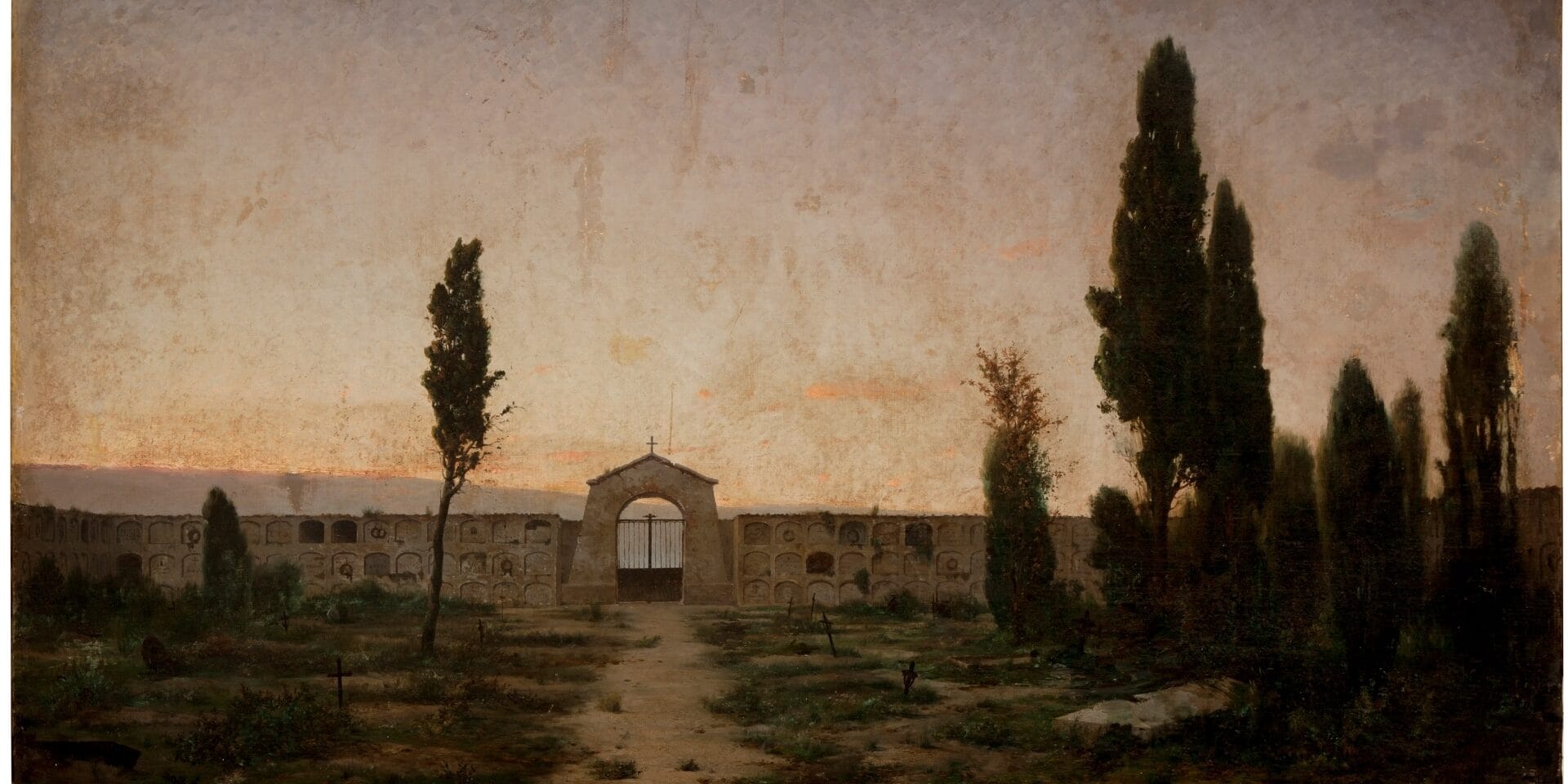
Érase un hombre que vivía junto a un cementerio parroquial
Traducción del inglés por M. Lizbeth Calvario S.
Texto original de M.R. James
Edición por Laura Lucía Urrea Moreno
Imagen: Cementerio, óleo sobre lienzo de Modesto Urgell e Inglada, 1878
Así empieza, como saben, el cuento de espectros y duendes que Mamilius, el niño mejor logrado en Shakespeare, le contaba a su regia madre, y a las damas de la corte, cuando el rey irrumpió con sus guardias para aprisionarla. Hasta ahí llega la historia; Mamilius murió poco después sin haber tenido la oportunidad de acabarla. Pero ¿qué hubiera terminado siendo? Shakespeare lo sabía, sin duda, y me atreveré a afirmar que yo también. No iba a ser una historia nueva: sería una que muy probablemente hayan oído o incluso contado. Cada quien es libre de enmarcarla donde mejor le parezca. Este es mi arreglo:
Érase un hombre que vivía junto a un cementerio parroquial. La planta baja de su casa era de piedra, y el primer piso, de madera. Las ventanas de enfrente daban a la calle, y las traseras, al cementerio. Hace tiempo le perteneció al sacerdote de la parroquia, pero (y esto fue en tiempos de la reina Isabel) era un hombre casado y necesitaba más espacio; además, a su esposa no le gustaba ver el cementerio de noche desde la ventana de su recámara. Contaba que veía… pero eso no importa; como sea, no dejó en paz a su esposo hasta que aceptó mudarse a una casa más grande en la calle del pueblo, y su vieja casa pasó a manos de John Poole, que era viudo y vivía ahí solo. Era un anciano bastante reservado y algo mezquino según decía la gente.
Y es probable que tuvieran razón: es verdad que tenía otros comportamientos malsanos. En aquellos tiempos lo común era enterrar a la gente de noche a la luz de las antorchas, y resultaba notorio que, cuando se avecinaba un funeral, John Poole se asomaba, ya fuera en la ventana de la planta baja o la del primer piso, según le conviniera una u otra para tener la mejor vista.
Una noche iban a enterrar a una vieja mujer. Era más bien pudiente, pero no le agradaba a nadie del pueblo. Se decían las cosas usuales sobre ella: que no era cristiana y que, en noches como la de San Juan o del Día de Todos los Santos, no la encontrarían en su casa. Tenía los ojos rojos, verla causaba espanto, y ningún mendigo tocaba a su puerta. Y, sin embargo, tras su muerte dejó una bolsa de dinero para la Iglesia.
No llovió la noche de su entierro; estaba despejado y en calma. Aún así, no fue fácil encontrar cargadores y hombres para portar las antorchas, pese a que, de hecho, había dejado un pago más generoso de lo acostumbrado para quienes hacían esa labor. La enterraron envuelta en lana, sin ataúd. No asistió nadie que no fuera indispensable… y John Poole, que observaba desde su ventana. Justo antes de que se cubriera la sepultura, el párroco se inclinó para arrojar algo sobre el cuerpo —algo tintineante— y masculló unas palabras que sonaron a “Que tu dinero yazga contigo”. Entonces se alejó con rapidez, y lo mismo hicieron los demás hombres, salvo un portaantorchas que se quedó para alumbrar al sacristán y a su monaguillo mientras paleaban la tierra. No hicieron un trabajo muy pulcro y, al día siguiente, que era domingo, los feligreses se mostraron severos con el sacristán, diciéndole que era la tumba más descuidada de todo el cementerio. Y, sí, cuando fue a verla, le pareció que se veía peor de lo que la había dejado.
Por su parte, John Poole se paseaba con un aire peculiar, entre satisfecho, por así decirlo, y nervioso. Más de una vez pasó la tarde en la posada, lo que era del todo contrario a su práctica habitual, y llegó a sugerirles a quienes le hacían plática que le había caído algún dinerito y que estaba buscando una casa un poco mejor.
—Pues no me sorprende ―le dijo el herrero una noche―. No querría vivir en su casa. Estaría figurándome cosas toda la noche.
El dueño de la posada le preguntó qué clase de cosas.
―Pues tal vez alguien trepando por mi ventana o algo similar ―respondió el herrero―. No sé… como la vieja Wilkins, a la que enterraron hace una semana.
―Creo que deberías pensar en el prójimo ―comentó el posadero―. No es muy agradable que digamos para el señor Poole, ¿o sí?
―Al señor Poole no le importa ―afirmó el herrero―. Lleva aquí suficiente para saberlo. Y solo dije que no fuera mi elección. Con lo del toque de difuntos, las antorchas de los sepelios y las tumbas tan calladas cuando no hay nadie cerca, pero dicen que hay luces. ¿Nunca no ha visto las luces, señor Poole?
―No. Nunca veo luz alguna ―respondió Poole de malas, pidió otro trago y regresó tarde a casa.
Aquella noche, mientras estaba acostado en su cama en el primer piso, un viento quejoso empezó a corretear por la casa, y no logró conciliar el sueño. Se levantó y caminó al otro lado del cuarto hasta un pequeño armario en la pared: sacó de él algo tintineante que se guardó en el pecho de su bata. Luego, caminó a la ventana y se asomó hacia el cementerio de la parroquia.
¿Han visto alguna vez un viejo bronce en una iglesia con la figura de un amortajado? Está hecho bola en la cabeza de una forma peculiar. Algo parecido sobresalía de la tierra en un pedazo del cementerio que John Poole conocía bastante bien. Corrió a meterse a su cama y se quedó acostado muy quieto.
De súbito algo provocó un leve rechinido en la ventana abatible. Con reticencia angustiosa, Poole dirigió su mirada en esa dirección. ¡Ahí! Entre él y la luz de la luna estaba la negra silueta con la cabeza hecha bola… pues había una figura en el cuarto. Tierra seca caía al piso. Una voz tenue y quebrada preguntó “¿Dónde está?” y los pasos fueron de acá para allá, el andar débil de alguien que camina con dificultad. Podía verse cada tanto, asomándose a los rincones, agachándose para buscar debajo de las sillas; por último, se le escuchó tanteando las puertas del armario en la pared, abriéndolas de par en par. Hubo un rechinido de uñas largas en los estantes vacíos. La figura dio la vuelta, se detuvo un instante al lado de la cama, levantó los brazos y, con un grito ronco de “¡TÚ LA TOMASTE!”—— En este punto, S. R. M. el Príncipe Mamilius (que, me parece, hubiera hecho el cuento bastante más corto que este) se abalanzó con un grito agudo sobre la más joven de las damas de la corte ahí presentes, que respondió con otro chillido igual de penetrante. Lo agarró de inmediato S. M. la reina Hermione, quien, conteniendo su disposición para reír, lo sacudió y azotó con severidad. Ruborizado y al borde del llanto, estaban a punto de mandarlo a la cama, pero, ante la intercesión de su víctima, que para entonces se había repuesto del sobresalto, se le permitió quedarse hasta su hora usual de irse a dormir; para entonces se había repuesto lo suficiente como para asegurar, mientras daba las buenas noches a la compañía, que sabía otra historia tres veces más atemorizante que esa, y que la contaría a la primera oportunidad.
There Was a Man Dwelt by a Churchyard
This, you know, is the beginning of the story about sprites and goblins which Mamilius, the best child in Shakespeare, was telling to his mother the queen, and the court ladies, when the king came in with his guards and hurried her off to prison. There is no more of the story; Mamilius died soon after without having a chance of finishing it. Now what was it going to have been? Shakespeare knew, no doubt, and I will be bold to say that I do. It was not going to be a new story: it was to be one which you have most likely heard, and even told. Everybody may set it in what frame he likes best. This is mine:
There was a man dwelt by a churchyard. His house had a lower story of stone and an upper one of timber. The front windows looked out on the street and the back ones on the churchyard. It had once belonged to the parish priest, but (this was in Queen Elizabeth’s days) the priest was a married man and wanted more room; besides, his wife disliked seeing the churchyard at night out of her bedroom window. She said she saw—but never mind what she said; anyhow, she gave her husband no peace till he agreed to move into a larger house in the village street, and the old one was taken by John Poole, who was a widower, and lived there alone. He was an elderly man who kept very much to himself, and people said he was something of a miser.
It was very likely true: he was morbid in other ways, certainly. In those days it was common to bury people at night and by torchlight: and it was noticed that whenever a funeral was toward, John Poole was always at his window, either on the ground floor or upstairs, according as he could get the better view from one or the other.
There came a night when an old woman was to be buried. She was fairly well to do, but she was not liked in the place. The usual thing was said of her, that she was no Christian, and that on such nights as Midsummer Eve and All Hallows, she was not to be found in her house. She was red-eyed and dreadful to look at, and no beggar ever knocked at her door. Yet when she died she left a purse of money to the Church.
There was no storm on the night of her burial; it was fair and calm. But there was some difficulty about getting bearers, and men to carry the torches, in spite of the fact that she had left larger fees than common for such as did that work. She was buried in woollen, without a coffin. No one was there but those who were actually needed—and John Poole, watching from his window. Just before the grave was filled in, the parson stooped down and cast something upon the body—something that clinked—and in a low voice he said words that sounded like “Thy money perish with thee.” Then he walked quickly away, and so did the other men, leaving only one torch-bearer to light the sexton and his boy while they shovelled the earth in. They made no very neat job of it, and next day, which was a Sunday, the church-goers were rather sharp with the sexton, saying it was the untidiest grave in the yard. And indeed, when he came to look at it himself, he thought it was worse than he had left it.
Meanwhile John Poole went about with a curious air, half exulting, as it were, and half nervous. More than once he spent an evening at the inn, which was clean contrary to his usual habit, and to those who fell into talk with him there he hinted that he had come into a little bit of money and was looking out for a somewhat better house. “Well, I don’t wonder,” said the smith one night, “I shouldn’t care for that place of yours. I should be fancying things all night.” The landlord asked him what sort of things.
“Well, maybe somebody climbing up to the chamber window, or the like of that,” said the smith. “I don’t know—old mother Wilkins that was buried a week ago to-day, eh?”
“Come, I think you might consider of a person’s feelings,” said the landlord. “It ain’t so pleasant for Master Poole, is it now?”
“Master Poole don’t mind,” said the smith. “He’s been there long enough to know. I only says it wouldn’t be my choice. What with the passing bell, and the torches when there’s a burial, and all them graves laying so quiet when there’s no one about: only they say there’s lights—don’t you never see no lights, Master Poole?”
“No, I don’t never see no lights,” said Master Poole sulkily, and called for another drink, and went home late.
That night, as he lay in his bed upstairs, a moaning wind began to play about the house, and he could not go to sleep. He got up and crossed the room to a little cupboard in the wall: he took out of it something that clinked, and put it in the breast of his bedgown. Then he went to the window and looked out into the churchyard.
Have you ever seen an old brass in a church with a figure of a person in a shroud? It is bunched together at the top of the head in a curious way. Something like that was sticking up out of the earth in a spot of the churchyard which John Poole knew very well. He darted into his bed and lay there very still indeed.
Presently something made a very faint rattling at the casement. With a dreadful reluctance John Poole turned his eyes that way. Alas! Between him and the moonlight was the black outline of the curious bunched head…. Then there was a figure in the room. Dry earth rattled on the floor. A low cracked voice said “Where is it?” and steps went hither and thither, faltering steps as of one walking with difficulty. It could be seen now and again, peering into corners, stooping to look under chairs; finally it could be heard fumbling at the doors of the cupboard in the wall, throwing them open. There was a scratching of long nails on the empty shelves. The figure whipped round, stood for an instant at the side of the bed, raised its arms, and with a hoarse scream of “YOU’VE GOT IT!”—— At this point H.R.H. Prince Mamilius (who would, I think, have made the story a good deal shorter than this) flung himself with a loud yell upon the youngest of the court ladies present, who responded with an equally piercing cry. He was instantly seized upon by H.M. Queen Hermione, who, repressing an inclination to laugh, shook and slapped him very severely. Much flushed, and rather inclined to cry, he was about to be sent to bed: but, on the intercession of his victim, who had now recovered from the shock, he was eventually permitted to remain until his usual hour for retiring; by which time he too had so far recovered as to assert, in bidding good night to the company, that he knew another story quite three times as dreadful as that one, and would tell it on the first opportunity that offered.!
(Tomado de James, M. R. The Collected Ghost Stories of M. R. James. Londres: Edward Arnold, 1931. Project Gutenberg Canada. https://gutenberg.ca/ebooks/jamesmr-collectedghoststories/jamesmr-collectedghoststories-00-h-dir/jamesmr-collectedghoststories-00-h.html)
There Was a Man Dwelt by a Churchyard
This, you know, is the beginning of the story about sprites and goblins which Mamilius, the best child in Shakespeare, was telling to his mother the queen, and the court ladies, when the king came in with his guards and hurried her off to prison. There is no more of the story; Mamilius died soon after without having a chance of finishing it. Now what was it going to have been? Shakespeare knew, no doubt, and I will be bold to say that I do. It was not going to be a new story: it was to be one which you have most likely heard, and even told. Everybody may set it in what frame he likes best. This is mine:
There was a man dwelt by a churchyard. His house had a lower story of stone and an upper one of timber. The front windows looked out on the street and the back ones on the churchyard. It had once belonged to the parish priest, but (this was in Queen Elizabeth’s days) the priest was a married man and wanted more room; besides, his wife disliked seeing the churchyard at night out of her bedroom window. She said she saw—but never mind what she said; anyhow, she gave her husband no peace till he agreed to move into a larger house in the village street, and the old one was taken by John Poole, who was a widower, and lived there alone. He was an elderly man who kept very much to himself, and people said he was something of a miser.
It was very likely true: he was morbid in other ways, certainly. In those days it was common to bury people at night and by torchlight: and it was noticed that whenever a funeral was toward, John Poole was always at his window, either on the ground floor or upstairs, according as he could get the better view from one or the other.
There came a night when an old woman was to be buried. She was fairly well to do, but she was not liked in the place. The usual thing was said of her, that she was no Christian, and that on such nights as Midsummer Eve and All Hallows, she was not to be found in her house. She was red-eyed and dreadful to look at, and no beggar ever knocked at her door. Yet when she died she left a purse of money to the Church.
There was no storm on the night of her burial; it was fair and calm. But there was some difficulty about getting bearers, and men to carry the torches, in spite of the fact that she had left larger fees than common for such as did that work. She was buried in woollen, without a coffin. No one was there but those who were actually needed—and John Poole, watching from his window. Just before the grave was filled in, the parson stooped down and cast something upon the body—something that clinked—and in a low voice he said words that sounded like “Thy money perish with thee.” Then he walked quickly away, and so did the other men, leaving only one torch-bearer to light the sexton and his boy while they shovelled the earth in. They made no very neat job of it, and next day, which was a Sunday, the church-goers were rather sharp with the sexton, saying it was the untidiest grave in the yard. And indeed, when he came to look at it himself, he thought it was worse than he had left it.
Meanwhile John Poole went about with a curious air, half exulting, as it were, and half nervous. More than once he spent an evening at the inn, which was clean contrary to his usual habit, and to those who fell into talk with him there he hinted that he had come into a little bit of money and was looking out for a somewhat better house. “Well, I don’t wonder,” said the smith one night, “I shouldn’t care for that place of yours. I should be fancying things all night.” The landlord asked him what sort of things.
“Well, maybe somebody climbing up to the chamber window, or the like of that,” said the smith. “I don’t know—old mother Wilkins that was buried a week ago to-day, eh?”
“Come, I think you might consider of a person’s feelings,” said the landlord. “It ain’t so pleasant for Master Poole, is it now?”
“Master Poole don’t mind,” said the smith. “He’s been there long enough to know. I only says it wouldn’t be my choice. What with the passing bell, and the torches when there’s a burial, and all them graves laying so quiet when there’s no one about: only they say there’s lights—don’t you never see no lights, Master Poole?”
“No, I don’t never see no lights,” said Master Poole sulkily, and called for another drink, and went home late.
That night, as he lay in his bed upstairs, a moaning wind began to play about the house, and he could not go to sleep. He got up and crossed the room to a little cupboard in the wall: he took out of it something that clinked, and put it in the breast of his bedgown. Then he went to the window and looked out into the churchyard.
Have you ever seen an old brass in a church with a figure of a person in a shroud? It is bunched together at the top of the head in a curious way. Something like that was sticking up out of the earth in a spot of the churchyard which John Poole knew very well. He darted into his bed and lay there very still indeed.
Presently something made a very faint rattling at the casement. With a dreadful reluctance John Poole turned his eyes that way. Alas! Between him and the moonlight was the black outline of the curious bunched head…. Then there was a figure in the room. Dry earth rattled on the floor. A low cracked voice said “Where is it?” and steps went hither and thither, faltering steps as of one walking with difficulty. It could be seen now and again, peering into corners, stooping to look under chairs; finally it could be heard fumbling at the doors of the cupboard in the wall, throwing them open. There was a scratching of long nails on the empty shelves. The figure whipped round, stood for an instant at the side of the bed, raised its arms, and with a hoarse scream of “YOU’VE GOT IT!”—— At this point H.R.H. Prince Mamilius (who would, I think, have made the story a good deal shorter than this) flung himself with a loud yell upon the youngest of the court ladies present, who responded with an equally piercing cry. He was instantly seized upon by H.M. Queen Hermione, who, repressing an inclination to laugh, shook and slapped him very severely. Much flushed, and rather inclined to cry, he was about to be sent to bed: but, on the intercession of his victim, who had now recovered from the shock, he was eventually permitted to remain until his usual hour for retiring; by which time he too had so far recovered as to assert, in bidding good night to the company, that he knew another story quite three times as dreadful as that one, and would tell it on the first opportunity that offered.!
Érase un hombre que vivía junto a un cementerio parroquial
Así empieza, como saben, el cuento de espectros y duendes que Mamilius, el niño mejor logrado en Shakespeare, le contaba a su regia madre, y a las damas de la corte, cuando el rey irrumpió con sus guardias para aprisionarla. Hasta ahí llega la historia; Mamilius murió poco después sin haber tenido la oportunidad de acabarla. Pero ¿qué hubiera terminado siendo? Shakespeare lo sabía, sin duda, y me atreveré a afirmar que yo también. No iba a ser una historia nueva: sería una que muy probablemente hayan oído o incluso contado. Cada quien es libre de enmarcarla donde mejor le parezca. Este es mi arreglo:
Érase un hombre que vivía junto a un cementerio parroquial. La planta baja de su casa era de piedra, y el primer piso, de madera. Las ventanas de enfrente daban a la calle, y las traseras, al cementerio. Hace tiempo le perteneció al sacerdote de la parroquia, pero (y esto fue en tiempos de la reina Isabel) era un hombre casado y necesitaba más espacio; además, a su esposa no le gustaba ver el cementerio de noche desde la ventana de su recámara. Contaba que veía… pero eso no importa; como sea, no dejó en paz a su esposo hasta que aceptó mudarse a una casa más grande en la calle del pueblo, y su vieja casa pasó a manos de John Poole, que era viudo y vivía ahí solo. Era un anciano bastante reservado y algo mezquino según decía la gente.
Y es probable que tuvieran razón: es verdad que tenía otros comportamientos malsanos. En aquellos tiempos lo común era enterrar a la gente de noche a la luz de las antorchas, y resultaba notorio que, cuando se avecinaba un funeral, John Poole se asomaba, ya fuera en la ventana de la planta baja o la del primer piso, según le conviniera una u otra para tener la mejor vista.
Una noche iban a enterrar a una vieja mujer. Era más bien pudiente, pero no le agradaba a nadie del pueblo. Se decían las cosas usuales sobre ella: que no era cristiana y que, en noches como la de San Juan o del Día de Todos los Santos, no la encontrarían en su casa. Tenía los ojos rojos, verla causaba espanto, y ningún mendigo tocaba a su puerta. Y, sin embargo, tras su muerte dejó una bolsa de dinero para la Iglesia.
No llovió la noche de su entierro; estaba despejado y en calma. Aún así, no fue fácil encontrar cargadores y hombres para portar las antorchas, pese a que, de hecho, había dejado un pago más generoso de lo acostumbrado para quienes hacían esa labor. La enterraron envuelta en lana, sin ataúd. No asistió nadie que no fuera indispensable… y John Poole, que observaba desde su ventana. Justo antes de que se cubriera la sepultura, el párroco se inclinó para arrojar algo sobre el cuerpo —algo tintineante— y masculló unas palabras que sonaron a “Que tu dinero yazga contigo”. Entonces se alejó con rapidez, y lo mismo hicieron los demás hombres, salvo un portaantorchas que se quedó para alumbrar al sacristán y a su monaguillo mientras paleaban la tierra. No hicieron un trabajo muy pulcro y, al día siguiente, que era domingo, los feligreses se mostraron severos con el sacristán, diciéndole que era la tumba más descuidada de todo el cementerio. Y, sí, cuando fue a verla, le pareció que se veía peor de lo que la había dejado.
Por su parte, John Poole se paseaba con un aire peculiar, entre satisfecho, por así decirlo, y nervioso. Más de una vez pasó la tarde en la posada, lo que era del todo contrario a su práctica habitual, y llegó a sugerirles a quienes le hacían plática que le había caído algún dinerito y que estaba buscando una casa un poco mejor.
—Pues no me sorprende ―le dijo el herrero una noche―. No querría vivir en su casa. Estaría figurándome cosas toda la noche.
El dueño de la posada le preguntó qué clase de cosas.
―Pues tal vez alguien trepando por mi ventana o algo similar ―respondió el herrero―. No sé… como la vieja Wilkins, a la que enterraron hace una semana.
―Creo que deberías pensar en el prójimo ―comentó el posadero―. No es muy agradable que digamos para el señor Poole, ¿o sí?
―Al señor Poole no le importa ―afirmó el herrero―. Lleva aquí suficiente para saberlo. Y solo dije que no fuera mi elección. Con lo del toque de difuntos, las antorchas de los sepelios y las tumbas tan calladas cuando no hay nadie cerca, pero dicen que hay luces. ¿Nunca no ha visto las luces, señor Poole?
―No. Nunca veo luz alguna ―respondió Poole de malas, pidió otro trago y regresó tarde a casa.
Aquella noche, mientras estaba acostado en su cama en el primer piso, un viento quejoso empezó a corretear por la casa, y no logró conciliar el sueño. Se levantó y caminó al otro lado del cuarto hasta un pequeño armario en la pared: sacó de él algo tintineante que se guardó en el pecho de su bata. Luego, caminó a la ventana y se asomó hacia al cementerio de la parroquia.
¿Han visto alguna vez un viejo bronce en una iglesia con la figura de un amortajado? Está hecho bola en la cabeza de una forma peculiar. Algo parecido sobresalía de la tierra en un pedazo del cementerio que John Poole conocía bastante bien. Corrió a meterse a su cama y se quedó acostado muy quieto.
De súbito algo provocó un leve rechinido en la ventana abatible. Con reticencia angustiosa, Poole dirigió su mirada en esa dirección. ¡Ahí! Entre él y la luz de la luna estaba la negra silueta con la cabeza hecha bola… pues había una figura en el cuarto. Tierra seca caía al piso. Una voz tenue y quebrada preguntó “¿Dónde está?” y los pasos fueron de acá para allá, el andar débil de alguien que camina con dificultad. Podía verse cada tanto, asomándose a los rincones, agachándose para buscar debajo de las sillas; por último, se le escuchó tanteando las puertas del armario en la pared, abriéndolas de par en par. Hubo un rechinido de uñas largas en los estantes vacíos. La figura dio la vuelta, se detuvo un instante al lado de la cama, levantó los brazos y, con un grito ronco de “¡TÚ LA TOMASTE!”—— En este punto, S. R. M. el Príncipe Mamilius (que, me parece, hubiera hecho el cuento bastante más corto que este) se abalanzó con un grito agudo sobre la más joven de las damas de la corte ahí presentes, que respondió con otro chillido igual de penetrante. Lo agarró de inmediato S. M. la reina Hermione, quien, conteniendo su disposición para reír, lo sacudió y azotó con severidad. Ruborizado y al borde del llanto, estaban a punto de mandarlo a la cama, pero, ante la intercesión de su víctima, que para entonces se había repuesto del sobresalto, se le permitió quedarse hasta su hora usual de irse a dormir; para entonces se había repuesto lo suficiente como para asegurar, mientras daba las buenas noches a la compañía, que sabía otra historia tres veces más atemorizante que esa, y que la contaría a la primera oportunidad.
M. Lizbeth Calvario S. (Ciudad de México, 1997) es licenciada en Lengua y Literaturas Modernas (Letras Inglesas) por la Universidad Nacional Autónoma de México (UNAM) y maestra en Traducción por El Colegio de México (Colmex), donde actualmente cursa el Doctorado en Letras Hispánicas. Sus líneas de interés son la transmisión-recepción, adaptaciones y traducciones de Shakespeare, alusiones a su vida y obra. Ha vertido al español textos de Nahum Tate, Arthur Conan Doyle, James Baldwin, Abraham Cowley y Hugh Holland. Sus traducciones, reseñas y artículos de investigación se han publicado o están por publicarse en Lingüística Mexicana. Nueva Época, Otros Diálogos de El Colegio de México, Notes and Queries, Hermenēus, Transfer y Anales Cervantinos.