
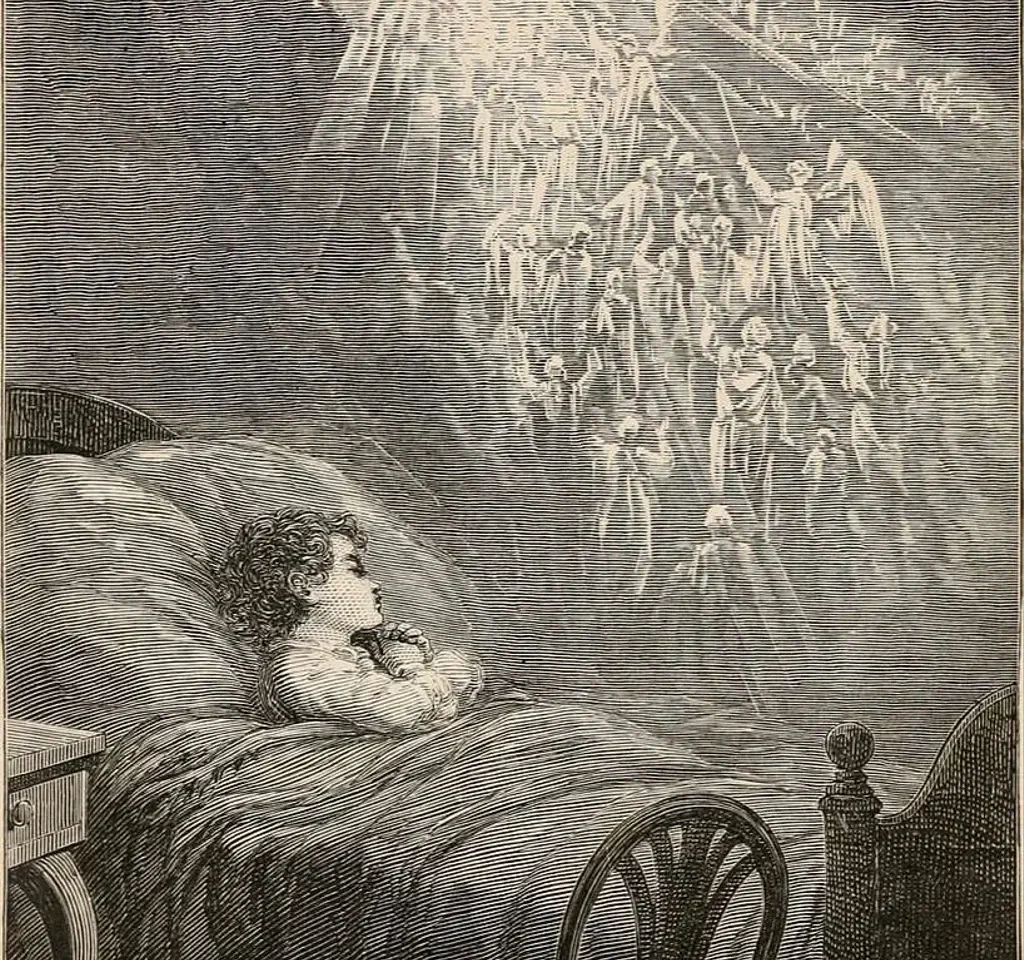
El sueño de un niño con una estrella
Traducción del inglés por Vanessa Lizbeth González Navarro
Texto original de Charles Dickens
Edición por Laura Rodríguez-Mejía
Imagen: A Child’s Dream of a Star, Charles Dickens, ilustraciones de Hammatt Billings, 1871.
Había una vez un niño que deambulaba y reflexionaba sobre muchas cosas. Tenía una hermana, también pequeña, que era su compañera inseparable. Ambos pasaban el día maravillados por la belleza de las flores, la altura y el azul del cielo, la profundidad del agua brillante, y la bondad y el poder de Dios, creador del maravilloso mundo.
Solían preguntarse el uno al otro: «Si todos los niños de la Tierra murieran, ¿las flores, el agua y el cielo se pondrían tristes?». Y creían que sí. Pues, decían, los capullos son los hijos de las flores, los pequeños arroyos juguetones que bajan saltando por las cuestas son los hijos del agua, y los pequeños destellos que juegan a las escondidas en el cielo por las noches deben ser los hijos de las estrellas. A todos ellos les entristecería no volver a ver a sus compañeros de juego, a los hijos de los hombres.
Había una estrella clara y brillante que solía aparecer en el cielo antes que las demás, cerca de lo alto de la torre de la iglesia, sobre las tumbas. Les parecía más grande y hermosa que las demás, y todas las noches la buscaban desde la ventana mientras se tomaban de las manos. Quien la veía primero gritaba: «¡Veo la estrella!». A menudo gritaban a la vez, pues sabían bien cuándo y dónde aparecería. Se hicieron tan amigos de ella que, antes de acostarse, se asomaban una vez más para desearle las buenas noches; y, al darse la vuelta para dormir, solían decir: «¡Que Dios bendiga a la estrella!».
Pero cuando todavía era joven, ¡oh, tan, tan, joven!, la hermana fue debilitándose hasta tal punto que ya no podía quedarse de pie junto a la ventana por las noches. El niño buscaba la estrella con tristeza, solo, y cuando la veía se giraba y decía al rostro pálido y paciente de su hermana en la cama: «¡Veo la estrella!». Y entonces una sonrisa se dibujaba en aquel rostro, y con su vocecita débil solía decir: «¡Dios bendiga a mi hermano y a la estrella!».
Y así llegó el momento, ¡demasiado pronto!, en que el niño miraba hacia afuera, solo. Ya no había ningún rostro en la cama; ahora había una pequeña tumba entre las demás, que antes no estaba allí, y la estrella proyectaba largos rayos hacia él, mientras la veía a través de sus lágrimas.
Ahora sus rayos eran tan deslumbrantes, y parecían trazar un camino luminoso desde la Tierra hasta el cielo, que, cuando el niño se acostaba en su cama solitaria, soñaba con la estrella, y soñaba que, desde donde estaba acostado, veía una fila de personas ser elevada por aquel camino destellante, guiadas por los ángeles. Y la estrella, al abrirse, le enseñaba un gran mundo de luz, donde muchos más ángeles esperaban para recibirlos.
Todos aquellos ángeles que aguardaban posaron sus radiantes ojos en las personas que eran llevadas hacia la estrella; algunos salieron de las largas filas en las que se encontraban y las abrazaron efusivamente, las besaron tiernamente y se marcharon con ellas por avenidas de luz, y eran tan felices en su compañía que, acostado en su cama, el niño lloró de alegría.
Pero había muchos ángeles que no se fueron con ellos, y entre ellos había uno que le era conocido. Aquel rostro paciente que una vez había reposado en la cama ahora estaba glorificado y radiante; su corazón reconoció a su hermana entre la multitud.
El ángel de su hermana permanecía cerca de la entrada de la estrella, y le preguntó al líder de los ángeles: «¿Ha venido mi hermano?».
Y él respondió: «No».
Se disponía a alejarse sin perder la esperanza, cuando el niño extendió los brazos y gritó: «¡Oh, hermana, aquí estoy! ¡Llévame!». Entonces ella posó sus radiantes ojos en él; era de noche, y la estrella brillaba dentro del cuarto, proyectando largos rayos hacia él mientras la veía a través de sus lágrimas.
Desde aquel momento, el niño miraba la estrella como el hogar al que habría de ir cuando su hora llegara; y pensaba que no pertenecía solo a la Tierra, sino también a la estrella, gracias al ángel de su hermana que había partido antes que él.
Nació un bebé que habría de ser hermano del niño; y aunque era tan pequeño que todavía no había pronunciado ni una sola palabra, se quedó tendido en su cama y murió.
El niño volvió a soñar con la estrella que se abría, con la compañía de los ángeles, con la fila de personas y con los ángeles que posaban sus radiantes ojos sobre ellas.
El ángel de su hermana le preguntó al líder: «¿Ha venido mi hermano?».
Y él respondió: «No ese, sino otro».
Cuando el niño vio al ángel de su hermanito en brazos de su hermana, gritó: «¡Oh, hermana, aquí estoy! ¡Llévame!». Y ella se giró y le sonrió, y la estrella brillaba.
Creció y se convirtió en un joven; estaba ocupado con sus libros cuando un criado se acercó a él y le dijo: «Tu madre ha muerto. ¡Traigo su bendición a su amado hijo!».
Esa noche volvió a ver la estrella y a toda aquella compañía celestial. El ángel de su hermana le preguntó al líder: «¿Ha venido mi hermano?»
Y él respondió: «¡Tu madre!».
Un inmenso grito de alegría se extendió por toda la estrella, porque la madre se había reunido con sus dos hijos. Y el joven estiró los brazos y gritó: «¡Oh, madre, hermana y hermano, aquí estoy! ¡Llévenme!»
Y ellos le respondieron: «Todavía no». Y la estrella brillaba.
Creció y se convirtió en un hombre cuyo cabello comenzaba a encanecer; y estaba sentado junto a la chimenea, abrumado por el duelo y con el rostro humedecido por las lágrimas, cuando la estrella volvió a abrirse.
El ángel de su hermana le preguntó al líder: «¿Ha venido mi hermano?».
Y él respondió: «No, sino su joven hija».
Y el hombre que una vez fue un niño vio a su hija, a quien acababa de perder, como un ser celestial entre aquellos tres, y dijo: «La cabeza de mi hija descansa sobre el pecho de mi hermana, y su brazo rodea el cuello de mi madre, y a sus pies yace el bebé de antaño, y puedo soportar que se separe de mí. ¡Alabado sea Dios!».
Y la estrella brillaba.
Así, el niño se convirtió en un anciano, y el rostro que alguna vez fue suave ahora estaba arrugado, y sus pasos eran lentos y débiles, y su espalda estaba encorvada. Una noche, mientras yacía en su cama, con sus hijos de pie a su alrededor, exclamó, tal como lo había hecho tantos años atrás: «¡Veo la estrella!».
Sus hijos susurraron entre ellos: «Está muriendo».
Y él respondió: «Sí, lo estoy. La vejez cae de mí como un manto, y avanzó hacia la estrella como un niño. ¡Oh, Padre mío, ahora te agradezco que tantas veces se haya abierto para recibir a aquellos seres queridos que me esperan!».
Y la estrella brillaba; y continúa brillando sobre su tumba.
Charles Dickens, A Child’s Dream of a Star. Tomado de https://www.gutenberg.org/files/42232/42232-h/42232-h.htm
A Child’s Dream of a Star
THERE was once a child, and he strolled about a good deal, and thought of a number of things. He had a sister, who was a child too, and his constant companion. These two used to wonder all day long. They wondered at the beauty of the flowers; they wondered at the height and blueness of the sky; they wondered at the depth of the bright water; they wondered at the goodness and the power of God, who made the lovely world.
They used to say to one another, sometimes, Supposing all the children upon earth were to die, would the flowers and the water and the sky be sorry? They believed they would be sorry. For, said they, the buds are the children of the flowers, and the little playful streams that gambol down the hillsides are the children of the water; and the smallest bright specks playing at hide-and-seek in the sky all night must surely be the children of the stars; and they would all be grieved to see their playmates, the children of men, no more.
There was one clear shining star that used to come out in the sky before the rest, near the church-spire, above the graves. It was larger and more beautiful, they thought, than all the others, and every night they watched for it, standing hand in hand at a window. Whoever saw it first cried out, “I see the star!” And often they cried out both together, knowing so well when it would rise and where. So they grew to be such friends with it, that, before lying down in their beds, they always looked out once again, to bid it good night; and when they were turning round to sleep, they used to say, “God bless the star!”
But while she was still very young, O, very, very young, the sister drooped, and came to be so weak that she could no longer stand in the window at night; and then the child looked sadly out by himself, and when he saw the star, turned round and said to the patient pale face on the bed, “I see the star!” And then a smile would come upon the face, and a little weak voice used to say, “God bless my brother and the star!”
And so the time came, all too soon! when the child looked out alone, and when there was no face on the bed; and when there was a little grave among the graves, not there before; and when the star made long rays down towards him, as he saw it through his tears.
Now, these rays were so bright, and they seemed to make such a shining way from earth to heaven, that when the child went to his solitary bed, he dreamed about the star; and dreamed that, lying where he was, he saw a train of people taken up that sparkling road by angels. And the star, opening, showed him a great world of light, where many more such angels waited to receive them.
All these angels, who were waiting, turned their beaming eyes upon the people who were carried up into the star; and some came out from the long rows in which they stood, and fell upon the people’s necks, and kissed them tenderly, and went away with them down avenues of light, and were so happy in their company, that, lying in his bed, he wept for joy.
But there were many angels who did not go with them, and among them one he knew. The patient face that once had lain upon the bed was glorified and radiant, but his heart found out his sister among all the host.
His sister’s angel lingered near the entrance of the star, and said to the leader among those who had brought the people thither, “Is my brother come?”
And he said, “No.”
She was turning hopefully away, when the child stretched out his arms, and cried, “O sister, I am here! Take me!” And then she turned her beaming eyes upon him, and it was night; and the star was shining into the room, making long rays down towards him as he saw it through his tears.
From that hour forth, the child looked out upon the star as on the home he was to go to, when his time should come; and he thought that he did not belong to the earth alone, but to the star too, because of his sister’s angel gone before.
There was a baby born to be a brother to the child; and while he was so little that he never yet had spoken word, he stretched his tiny form out on his bed, and died.
Again the child dreamed of the opened star, and of the company of angels, and the train of people, and the rows of angels with their beaming eyes all turned upon those people’s faces.
Said his sister’s angel to the leader, “Is my brother come?”
And he said, “Not that one, but another.”
As the child beheld his brother’s angel in her arms, he cried, “O sister, I am here! Take me!” And she turned and smiled upon him, and the star was shining.
He grew to be a young man, and was busy at his books when an old servant came to him and said, “Thy mother is no more. I bring her blessing on her darling son!”
Again at night he saw the star, and all that former company. Said his sister’s angel to the leader, “Is my brother come?”
And he said, “Thy mother!”
A mighty cry of joy went forth through all the star, because the mother was reunited to her two children. And he stretched out his arms and cried, “O mother, sister, and brother, I am here! Take me!”
And they answered him, “Not yet.” And the star was shining.
He grew to be a man, whose hair was turning gray; and he was sitting in his chair by the fireside, heavy with grief, and with his face bedewed with tears, when the star opened once again.
Said his sister’s angel to the leader, “Is my brother come?”
And he said, “Nay, but his maiden daughter.”
And the man who had been the child saw his daughter, newly lost to him, a celestial creature among those three, and he said, “My daughter’s head is on my sister’s bosom, and her arm is round my mother’s neck, and at her feet there is the baby of old time, and I can bear the parting from her, God be praised!”
And the star was shining.
Thus the child came to be an old man, and his once smooth face was wrinkled, and his steps were slow and feeble, and his back was bent. And one night as he lay upon his bed, his children standing round, he cried, as he had cried so long ago, “I see the star!”
They whispered one another, “He is dying.”
And he said, “I am. My age is falling from me like a garment, and I move towards the star as a child. And O my Father, now I thank thee that it has so often opened to receive those dear ones who await me!”And the star was shining; and it shines upon his grave.
A Child’s Dream of a Star
THERE was once a child, and he strolled about a good deal, and thought of a number of things. He had a sister, who was a child too, and his constant companion. These two used to wonder all day long. They wondered at the beauty of the flowers; they wondered at the height and blueness of the sky; they wondered at the depth of the bright water; they wondered at the goodness and the power of God, who made the lovely world.
They used to say to one another, sometimes, Supposing all the children upon earth were to die, would the flowers and the water and the sky be sorry? They believed they would be sorry. For, said they, the buds are the children of the flowers, and the little playful streams that gambol down the hillsides are the children of the water; and the smallest bright specks playing at hide-and-seek in the sky all night must surely be the children of the stars; and they would all be grieved to see their playmates, the children of men, no more.
There was one clear shining star that used to come out in the sky before the rest, near the church-spire, above the graves. It was larger and more beautiful, they thought, than all the others, and every night they watched for it, standing hand in hand at a window. Whoever saw it first cried out, “I see the star!” And often they cried out both together, knowing so well when it would rise and where. So they grew to be such friends with it, that, before lying down in their beds, they always looked out once again, to bid it good night; and when they were turning round to sleep, they used to say, “God bless the star!”
But while she was still very young, O, very, very young, the sister drooped, and came to be so weak that she could no longer stand in the window at night; and then the child looked sadly out by himself, and when he saw the star, turned round and said to the patient pale face on the bed, “I see the star!” And then a smile would come upon the face, and a little weak voice used to say, “God bless my brother and the star!”
And so the time came, all too soon! when the child looked out alone, and when there was no face on the bed; and when there was a little grave among the graves, not there before; and when the star made long rays down towards him, as he saw it through his tears.
Now, these rays were so bright, and they seemed to make such a shining way from earth to heaven, that when the child went to his solitary bed, he dreamed about the star; and dreamed that, lying where he was, he saw a train of people taken up that sparkling road by angels. And the star, opening, showed him a great world of light, where many more such angels waited to receive them.
All these angels, who were waiting, turned their beaming eyes upon the people who were carried up into the star; and some came out from the long rows in which they stood, and fell upon the people’s necks, and kissed them tenderly, and went away with them down avenues of light, and were so happy in their company, that, lying in his bed, he wept for joy.
But there were many angels who did not go with them, and among them one he knew. The patient face that once had lain upon the bed was glorified and radiant, but his heart found out his sister among all the host.
His sister’s angel lingered near the entrance of the star, and said to the leader among those who had brought the people thither, “Is my brother come?”
And he said, “No.”
She was turning hopefully away, when the child stretched out his arms, and cried, “O sister, I am here! Take me!” And then she turned her beaming eyes upon him, and it was night; and the star was shining into the room, making long rays down towards him as he saw it through his tears.
From that hour forth, the child looked out upon the star as on the home he was to go to, when his time should come; and he thought that he did not belong to the earth alone, but to the star too, because of his sister’s angel gone before.
There was a baby born to be a brother to the child; and while he was so little that he never yet had spoken word, he stretched his tiny form out on his bed, and died.
Again the child dreamed of the opened star, and of the company of angels, and the train of people, and the rows of angels with their beaming eyes all turned upon those people’s faces.
Said his sister’s angel to the leader, “Is my brother come?”
And he said, “Not that one, but another.”
As the child beheld his brother’s angel in her arms, he cried, “O sister, I am here! Take me!” And she turned and smiled upon him, and the star was shining.
He grew to be a young man, and was busy at his books when an old servant came to him and said, “Thy mother is no more. I bring her blessing on her darling son!”
Again at night he saw the star, and all that former company. Said his sister’s angel to the leader, “Is my brother come?”
And he said, “Thy mother!”
A mighty cry of joy went forth through all the star, because the mother was reunited to her two children. And he stretched out his arms and cried, “O mother, sister, and brother, I am here! Take me!”
And they answered him, “Not yet.” And the star was shining.
He grew to be a man, whose hair was turning gray; and he was sitting in his chair by the fireside, heavy with grief, and with his face bedewed with tears, when the star opened once again.
Said his sister’s angel to the leader, “Is my brother come?”
And he said, “Nay, but his maiden daughter.”
And the man who had been the child saw his daughter, newly lost to him, a celestial creature among those three, and he said, “My daughter’s head is on my sister’s bosom, and her arm is round my mother’s neck, and at her feet there is the baby of old time, and I can bear the parting from her, God be praised!”
And the star was shining.
Thus the child came to be an old man, and his once smooth face was wrinkled, and his steps were slow and feeble, and his back was bent. And one night as he lay upon his bed, his children standing round, he cried, as he had cried so long ago, “I see the star!”
They whispered one another, “He is dying.”
And he said, “I am. My age is falling from me like a garment, and I move towards the star as a child. And O my Father, now I thank thee that it has so often opened to receive those dear ones who await me!”And the star was shining; and it shines upon his grave.
El sueño de un niño con una estrella
Había una vez un niño que deambulaba y reflexionaba sobre muchas cosas. Tenía una hermana, también pequeña, que era su compañera inseparable. Ambos pasaban el día maravillados por la belleza de las flores, la altura y el azul del cielo, la profundidad del agua brillante, y la bondad y el poder de Dios, creador del maravilloso mundo.
Solían preguntarse el uno al otro: «Si todos los niños de la tierra murieran, ¿las flores, el agua y el cielo se pondrían tristes?». Y creían que sí. Pues, decían, los capullos son los hijos de las flores, los pequeños arroyos juguetones que bajan saltando por las cuestas son los hijos del agua, y los pequeños destellos que juegan a las escondidas en el cielo por las noches deben ser los hijos de las estrellas. A todos ellos les entristecería no volver a ver a sus compañeros de juego, a los hijos de los hombres.
Había una estrella clara y brillante que solía aparecer en el cielo antes que las demás, cerca de lo alto de la torre de la iglesia, sobre las tumbas. Les parecía más grande y hermosa que las demás, y todas las noches la buscaban desde la ventana mientras se tomaban de las manos. Quien la veía primero gritaba: «¡Veo la estrella!». A menudo gritaban a la vez, pues sabían bien cuándo y dónde aparecería. Se hicieron tan amigos de ella que, antes de acostarse, se asomaban una vez más para desearle buenas noches; y, al darse la vuelta para dormir, solían decir: «¡Que Dios bendiga a la estrella!».
Pero cuando todavía era joven, ¡oh, tan, tan, joven!, la hermana fue debilitándose hasta tal punto que ya no podía quedarse de pie junto a la ventana por las noches. El niño buscaba la estrella con tristeza, solo, y cuando la veía se giraba y decía al rostro pálido y paciente de su hermana en la cama: «¡Veo la estrella!». Y entonces una sonrisa se dibujaba en aquel rostro, y con su vocecita débil solía decir: «¡Dios bendiga a mi hermano y a la estrella!»
Y así llegó el momento, ¡demasiado pronto!, en que el niño miraba hacia afuera, solo. Ya no había ningún rostro en la cama; ahora había una pequeña tumba entre las demás, que antes no estaba allí, y la estrella proyectaba largos rayos hacia él, mientras la veía a través de sus lágrimas.
Ahora sus rayos eran tan deslumbrantes, y parecían trazar un camino luminoso desde la tierra hasta el cielo, que, cuando el niño se acostaba en su cama solitaria, soñaba con la estrella, y soñaba que, desde donde estaba acostado, veía una fila de personas ser elevada por aquel camino destellante, guiadas por los ángeles. Y la estrella, al abrirse, le enseñaba un gran mundo de luz, donde muchos más ángeles esperaban para recibirlos.
Todos aquellos ángeles que aguardaban posaron sus radiantes ojos en las personas que eran llevadas hacia la estrella; algunos salieron de las largas filas en las que se encontraban y las abrazaron efusivamente, las besaron tiernamente y se marcharon con ellas por avenidas de luz, y eran tan felices en su compañía que, acostado en su cama, el niño lloró de alegría.
Pero había muchos ángeles que no se fueron con ellos, y entre ellos había uno que le era conocido. Aquel rostro paciente que una vez había reposado en la cama ahora estaba glorificado y radiante; su corazón reconoció a su hermana entre toda la multitud.
El ángel de su hermana permanecía cerca de la entrada de la estrella, y le preguntó al líder de los ángeles: «¿Ha venido mi hermano?»
Y él respondió: «No.»
Se disponía a alejarse sin perder la esperanza, cuando el niño extendió los brazos y gritó: «¡Oh, hermana, aquí estoy! ¡Llévame!». Entonces ella posó sus radiantes ojos en él; era de noche, y la estrella brillaba dentro del cuarto, proyectando largos rayos hacia él mientras la veía a través de sus lágrimas.
Desde aquel momento, el niño miraba la estrella como el hogar al que había de ir cuando su hora llegara; y pensaba que no pertenecía solo a la tierra, sino también a la estrella, gracias al ángel de su hermana que había partido antes que él.
Nació un bebé que habría de ser hermano del niño; y aunque era tan pequeño que todavía no había pronunciado ni una sola palabra, se quedó tendido en su cama y murió.
El niño volvió a soñar con la estrella que se abría, con la compañía de los ángeles, con la fila de personas y con los ángeles que posaban sus radiantes ojos sobre ellas.
El ángel de su hermana le preguntó al líder: «¿Ha venido mi hermano?»
Y él respondió: «No ese, sino otro.»
Cuando el niño vio al ángel de su hermanito en brazos de su hermana, gritó: «¡Oh, hermana, aquí estoy! ¡Llévame!». Y ella se giró y le sonrió, y la estrella brillaba.
Creció y se convirtió en un joven; estaba ocupado con sus libros cuando un criado se acercó a él y le dijo: «Tu madre ha muerto. ¡Traigo su bendición a su amado hijo!»
Esa noche volvió a ver la estrella y a toda aquella compañía celestial. El ángel de su hermana le preguntó al líder: «¿Ha venido mi hermano?»
Y él respondió: «¡Tu madre!»
Un inmenso grito de alegría se extendió por toda la estrella, porque la madre se había reunido con sus dos hijos. Y el joven estiró los brazos y gritó: «¡Oh, madre, hermana y hermano, aquí estoy! ¡Llévenme!»
Y ellos le respondieron: «Todavía no». Y la estrella brillaba.
Creció y se convirtió en un hombre cuyo cabello comenzaba a encanecer; y estaba sentado junto a la chimenea, abrumado por el dolor y con el rostro humedecido por las lágrimas, cuando la estrella volvió a abrirse.
El ángel de su hermana le preguntó al líder: «¿Ha venido mi hermano?»
Y él respondió: «No, sino su joven hija.»
Y el hombre que una vez fue un niño vio a su hija, a quien acababa de perder, como un ser celestial entre aquellos tres, y dijo: «La cabeza de mi hija descansa sobre el pecho de mi hermana, y su brazo rodea el cuello de mi madre, y a sus pies yace el bebé de antaño, y puedo soportar que se separe de mí. ¡Alabado sea Dios!»
Y la estrella brillaba.
Así, el niño se convirtió en un anciano, y el rostro que alguna vez fue suave ahora estaba arrugado, y sus pasos eran lentos y débiles, y su espalda estaba encorvada. Una noche, mientras yacía en su cama, con sus hijos de pie a su alrededor, exclamó, tal como lo había hecho tantos años atrás: «¡Veo la estrella!»
Sus hijos susurraron entre ellos: «Está muriendo».
Y él respondió: «Sí, lo estoy. La vejez cae de mí como un manto, y avanzo hacia la estrella como un niño. ¡Oh, Padre mío, ahora te agradezco que tantas veces se haya abierto para recibir a aquellos seres queridos que me esperan!»Y la estrella brillaba; y continúa brillando sobre su tumba.
Uno de los principales retos de esta traducción fue trabajar con un texto escrito en el siglo XIX, ya que algunas expresiones del inglés de la época no tienen equivalentes directos en el español actual. También fue necesario reflexionar sobre cómo abordar el tema de la muerte en un cuento dirigido a niños. Mi objetivo fue conservar la sensibilidad y la esperanza presentes en el relato, manteniendo un equilibrio entre la fidelidad al texto original y una lectura natural para el público hispanohablante.
Vanessa Lizbeth González Navarro es estudiante de Lingüística Aplicada a la Enseñanza y Traducción del Idioma Inglés en la Universidad Autónoma de Nuevo León. Su pasión por la traducción nace de ver el lenguaje como un arte capaz de conectar mundos. Para esta convocatoria seleccionó A Child’s Dream of a Star, de Charles Dickens, atraída por la delicadeza con la que aborda la muerte en una obra infantil. Considera que este texto ofrece una doble lectura: una historia fantástica en la niñez y una profunda pieza emocional en la adultez. A través de este trabajo, busca acercar este clásico a nuevos lectores, convencida de que la traducción literaria es un puente para que estás profundas obras y sean entendidas en cualquier rincón del mundo.