
El fantasma de Canterville (segundo capítulo)
Traducción del inglés por David Ulises Franco León
Texto original de Oscar Wilde
Edición por Laura Lucía Urrea Moreno
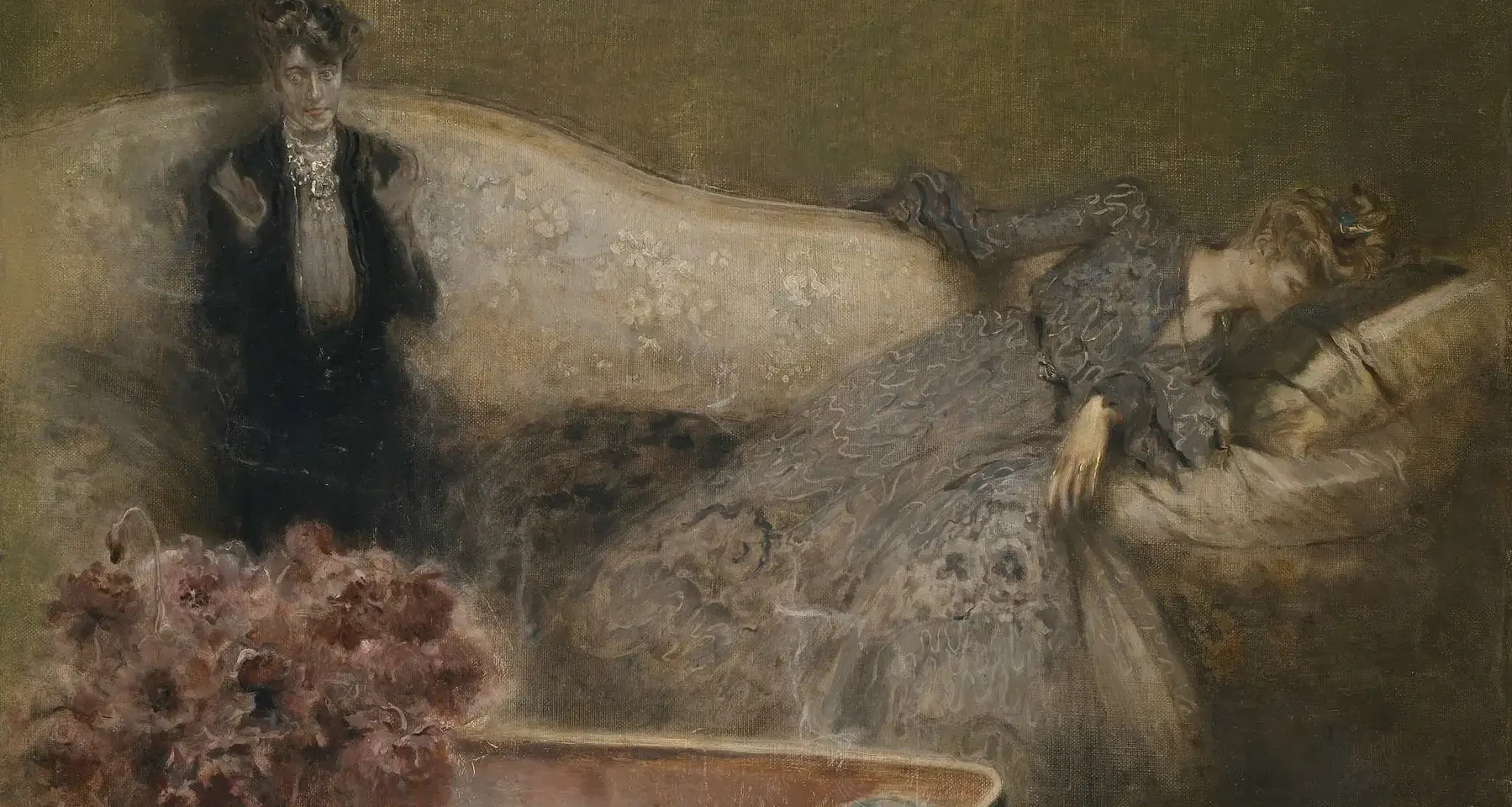
Imagen: Morfinomani, óleo sobre lienzo de Serafino Macchiati, s. f.
La tormenta sonó violentamente durante toda la noche, pero no sucedió nada particularmente importante. A la mañana siguiente, sin embargo, cuando bajaron a desayunar, se volvieron a encontrar con la horrible mancha de sangre en el piso. “No creo que sea culpa del Detergente Paragon” dijo Washington, “ya que lo he usado con todo. Debió ser el fantasma”. Refregó la mancha por segunda vez, pero a la mañana siguiente apareció de nuevo. A la mañana del tercer día estaba otra vez allí, a pesar de que Mr. Otis había dejado la biblioteca cerrada bajo llave la noche anterior, y había llevado las llaves al segundo piso. Ahora la familia se encontraba bastante intrigada; Mr. Otis empezó a sospechar que había sido muy dogmático al negar la existencia de los fantasmas, y Mrs. Otis expresó su intención de unirse a la Sociedad Psíquica. Esa noche toda duda sobre la posible existencia de los fantasmas desapareció para siempre.
El día estuvo caluroso y soleado; y en el fresco de la tarde, toda la familia salió a dar un paseo en coche. Regresaron a casa después de las nueve, y comieron algo ligero. La conversación nunca incluyó una discusión sobre fantasmas, por lo que ni siquiera existían las condiciones apropiadas de expectativa receptiva que normalmente preceden a los fenómenos psíquicos.
No hubo mención alguna de lo sobrenatural, y no se mencionó tampoco a Sir Simon de Canterville de ninguna manera. A las once en punto la familia se fue a la cama, y para las once y media todas las luces estaban apagadas. Un poco más tarde, a Mr. Otis lo despertó un sonido extraño en el corredor, afuera de su cuarto. Era como un sonido metálico, y parecía acercarse cada vez más. Se levantó de inmediato, encendió una vela, y miró la hora. Eran exactamente la una en punto. Estaba bastante tranquilo, y se midió el pulso, que no era febril de ningún modo. El extraño sonido continuaba, y con este escuchó también el inconfundible sonido de unas pisadas. Se puso sus pantuflas, agarró un pequeño frasco de vidrio del cajón, y abrió la puerta. Justo en frente suyo vio, bajo la pálida luz de la luna, a un hombre viejo con apariencia horrible. Los ojos eran rojos como carbón encendido; el cabello largo y grisáceo le caía sobre los hombros en rizos grasientos; la ropa, de un estilo antiguo, estaba sucia y rota, y de las muñecas y los tobillos colgaban grilletes pesados y cadenas oxidadas.
“Mi estimado señor”, dijo Mr. Otis, “debo insistir en que aceite esas cadenas, por lo que le he traído esta pequeña botella de Lubricante Sol Naciente Tammany. Dicen que funciona a la primera pasada. La dejaré al lado de las velas del cuarto para usted, y estaría encantado de traerle más si usted así lo necesita.”
Con estas palabras el ministro de los Estados Unidos puso la botella sobre una mesa de mármol, y, después de cerrar la puerta, volvió a la cama.
Por un momento, el fantasma de Canterville se quedó inmóvil de indignación; después, tras tumbar la botella abruptamente sobre el suelo encerado, corrió por el corredor, gruñendo y emitiendo una luz verde espectral. Pero, justo antes de llegar a la cima de la gran escalera de roble, ¡una puerta se abrió con fuerza, aparecieron dos pequeñas figuras, y una almohada grande voló sobre su cabeza! Evidentemente no había tiempo que perder, entonces, usando la Cuarta Dimensión del Espacio como medio de escape, se desvaneció rápidamente a través de la pared, y la casa quedó completamente en silencio.
Al llegar a una pequeña habitación secreta en el ala izquierda de la casa, se inclinó hacia la luz de la luna para recuperar el aliento, y trató de entender su posición. Nunca, en sus más de trescientos años de carrera excepcional, se había sentido tan insultado.
Pensó en la Duquesa, a quien hizo desmayar del susto cuando estaba frente al espejo con sus encajes y diamantes; en las cuatro criadas, que se pusieron histéricas cuando les sonrió a través de las cortinas de una de las habitaciones de huéspedes; en el cura, al que le apagó la vela cuando salía tarde de la biblioteca, y al que seguían tratando por un desorden nervioso; y en la anciana Madame de Tremoulliac, que, al despertar temprano un día y ver un esqueleto sentado en el sillón frente al fuego, leyendo su diario, quedó confinada a la cama por seis semanas con fiebre cerebral. Recordó la horrible noche en la que encontraron al malvado Lord Canterville a punto de asfixiarse en su vestidor con un naipe en la mitad de su garganta, y confesó, justo antes de morir, que había engañado a Charles James Fox, ganándole 50.000 libras mientras jugaban a las cartas, y juró que el fantasma lo había obligado a tragársela. Todos sus grandes logros se le vinieron a la mente, desde el criado que se disparó porque había visto una mano verde golpeando la ventana, hasta la hermosa Lady Stutfield, que tenía que usar una banda negra de terciopelo alrededor de su cuello para esconder la quemadura de cinco dedos impresa en su piel blanca, y que se arrojó al estanque del jardín para ahogarse. Con el entusiasmo de un verdadero artista, repasó sus más grandes obras. Y después de todo esto, unos miserables americanos modernos venían a ofrecerle el lubricante Sol Naciente, y le tiraban almohadas a la cabeza. ¡Era algo insoportable! Además, ningún fantasma en la historia había recibido semejante trato. Entonces decidió tomar venganza, y se quedó hasta la mañana siguiente en profunda meditación.
The Canterville Ghost (Second Chapter)
The storm raged fiercely all that night, but nothing of particular note happened. The next morning, however, when they came down to breakfast, they found the terrible stain of blood once again on the floor. “I don’t think it can be the fault of the Paragon Detergent”, said Washington, “for I have tried it with everything. It must be the ghost.” He then rubbed out the stain a second time, but the second morning it appeared again. The third morning also it was there, though the library had been locked up at night by Mr Otis himself, and the key carried upstairs. The whole family were now quite interested; Mr Otis began to suspect that he had been too dogmatic in his denial of the existence of ghosts, and Mrs Otis expressed her intention of joining the Psychical Society. That night all doubts about the actual existence of phantoms were removed for ever.
The day had been warm and sunny; and in the cool of the evening, the whole family went out for a drive. They did not return home till nine o’clock, when they had a light supper. The conversation in no way included a discussion of ghosts, so there were not even the right conditions of receptive expectation which so often precede psychical phenomena.
No mention at all was made of the supernatural, nor was Sir Simon de Canterville mentioned in any way. At eleven o’clock the family went to bed and by half past eleven all the lights were out. Some time after, Mr Otis was awakened by a curious noise in the corridor, outside his room. It sounded like the clank of metal, and seemed to be coming nearer every moment. He got up at once, struck a match, and looked at the time. It was exactly one o’clock. He was quite calm and felt his pulse, which was not at all feverish. The strange noise still continued, and with it he heard the distinct sound of footsteps. He put on his slippers, took a small glass bottle out of the drawer, and opened the door. Right in front of him he saw, in the pale moonlight, an old man of terrible appearance. His eyes were as red as burning coals; his long grey hair fell over his shoulders in greasy curls; his clothes, which were of an ancient style, were dirty and ragged, and from his wrists and ankles hung heavy manacles and rusty chains.
“My dear sir” said Mr Otis, “I really must insist on your oiling those chains, and have brought you for that purpose a small bottle of Tammany Rising Sun Lubricator. They say it works at once. I shall leave it here for you by the bedroom candles, and will be happy to supply you with more should you require it.”
With these words the United States Minister laid the bottle down on a marble table, and, closing his door, went back to bed.
For a moment the canterville ghost stood quite motionless in natural indignation; then, knocking the bottle violently onto the polished floor, he ran down the corridor, groaning and giving out a ghastly green light. Just, however, as he reached the top of the great oak staircase, a door was thrown open, two little figures appeared, and a large pillow flew past his head! There was evidently no time to be lost, so, quickly, using the Fourth Dimension of Space as a means of escape, he vanished through the wall, and the house became completely quiet.
On reaching a small secret chamber in the left wing of the house, he leaned up against a moonbeam to recover his breath, and began to try and understand his position. Never, in a brilliant career of three hundred years, had he been so badly insulted.
He thought of the Duchess, whom he had frightened into a fit as she stood before the mirror in her lace and diamonds; of the four housemaids, who had gone off into hysterics when he just grinned at them through the curtains of one of the spare bedrooms; of the priest whose candle he had blown out as he was coming late one night from the library, and who was still being treated for a nervous disorder; and of old Madame de Tremoulliac, who, having wakened up one morning early and seen a skeleton seated in an arm-chair by the fire reading her diary, had been confined to her bed for six weeks with an attack of brain fever.
He remembered the terrible night when the wicked Lord Canterville was found choking in his dressing-room with a card half way down his throat, and confessed, just before he died, that he had cheated Charles James Fox out of £50,000 while they were playing cards, and swore that the ghost had made him swallow it. All his great achievements came back to him again, from the manservant who had shot himself because he had seen a green hand knocking at the window, to the beautiful Lady Stutfield, who always wore a black velvet band round her throat to hide the mark of five fingers burnt upon her white skin, and who drowned herself in the fish-pond in the garden. With the enthusiasm of a true artist, he went over his most celebrated performances. And after all this, some wretched modern Americans had come and offered him the Rising Sun Lubricator, and thrown pillows at his head. It was quite unbearable! Besides, no ghosts in history had been treated in this way. So he decided to have revenge, and remained till daylight deep in thought.
(Tomado de Wilde, O., The Canterville Ghost, HELBLING LANGUAGES, 2007)
The Canterville Ghost (Second Chapter)
The storm raged fiercely all that night, but nothing of particular note happened. The next morning, however, when they came down to breakfast, they found the terrible stain of blood once again on the floor. “I don’t think it can be the fault of the Paragon Detergent”, said Washington, “for I have tried it with everything. It must be the ghost.” He then rubbed out the stain a second time, but the second morning it appeared again. The third morning also it was there, though the library had been locked up at night by Mr Otis himself, and the key carried upstairs. The whole family were now quite interested; Mr Otis began to suspect that he had been too dogmatic in his denial of the existence of ghosts, and Mrs Otis expressed her intention of joining the Psychical Society. That night all doubts about the actual existence of phantoms were removed for ever.
The day had been warm and sunny; and in the cool of the evening, the whole family went out for a drive. They did not return home till nine o’clock, when they had a light supper. The conversation in no way included a discussion of ghosts, so there were not even the right conditions of receptive expectation which so often precede psychical phenomena.
No mention at all was made of the supernatural, nor was Sir Simon de Canterville mentioned in any way. At eleven o’clock the family went to bed and by half past eleven all the lights were out. Some time after, Mr Otis was awakened by a curious noise in the corridor, outside his room. It sounded like the clank of metal, and seemed to be coming nearer every moment. He got up at once, struck a match, and looked at the time. It was exactly one o’clock. He was quite calm and felt his pulse, which was not at all feverish. The strange noise still continued, and with it he heard the distinct sound of footsteps. He put on his slippers, took a small glass bottle out of the drawer, and opened the door. Right in front of him he saw, in the pale moonlight, an old man of terrible appearance. His eyes were as red as burning coals; his long grey hair fell over his shoulders in greasy curls; his clothes, which were of an ancient style, were dirty and ragged, and from his wrists and ankles hung heavy manacles and rusty chains.
“My dear sir” said Mr Otis, “I really must insist on your oiling those chains, and have brought you for that purpose a small bottle of Tammany Rising Sun Lubricator. They say it works at once. I shall leave it here for you by the bedroom candles, and will be happy to supply you with more should you require it.”
With these words the United States Minister laid the bottle down on a marble table, and, closing his door, went back to bed.
For a moment the canterville ghost stood quite motionless in natural indignation; then, knocking the bottle violently onto the polished floor, he ran down the corridor, groaning and giving out a ghastly green light. Just, however, as he reached the top of the great oak staircase, a door was thrown open, two little figures appeared, and a large pillow flew past his head! There was evidently no time to be lost, so, quickly, using the Fourth Dimension of Space as a means of escape, he vanished through the wall, and the house became completely quiet.
On reaching a small secret chamber in the left wing of the house, he leaned up against a moonbeam to recover his breath, and began to try and understand his position. Never, in a brilliant career of three hundred years, had he been so badly insulted.
He thought of the Duchess, whom he had frightened into a fit as she stood before the mirror in her lace and diamonds; of the four housemaids, who had gone off into hysterics when he just grinned at them through the curtains of one of the spare bedrooms; of the priest whose candle he had blown out as he was coming late one night from the library, and who was still being treated for a nervous disorder; and of old Madame de Tremoulliac, who, having wakened up one morning early and seen a skeleton seated in an arm-chair by the fire reading her diary, had been confined to her bed for six weeks with an attack of brain fever.
He remembered the terrible night when the wicked Lord Canterville was found choking in his dressing-room with a card half way down his throat, and confessed, just before he died, that he had cheated Charles James Fox out of £50,000 while they were playing cards, and swore that the ghost had made him swallow it. All his great achievements came back to him again, from the manservant who had shot himself because he had seen a green hand knocking at the window, to the beautiful Lady Stutfield, who always wore a black velvet band round her throat to hide the mark of five fingers burnt upon her white skin, and who drowned herself in the fish-pond in the garden. With the enthusiasm of a true artist, he went over his most celebrated performances. And after all this, some wretched modern Americans had come and offered him the Rising Sun Lubricator, and thrown pillows at his head. It was quite unbearable! Besides, no ghosts in history had been treated in this way. So he decided to have revenge, and remained till daylight deep in thought.
El fantasma de Canterville (segundo capítulo)
La tormenta sonó violentamente durante toda la noche, pero no sucedió nada particularmente importante. A la mañana siguiente, sin embargo, cuando bajaron a desayunar, se volvieron a encontrar con la horrible mancha de sangre en el piso. “No creo que sea culpa del Detergente Paragon” dijo Washington, “ya que lo he usado con todo. Debió ser el fantasma”. Refregó la mancha por segunda vez, pero a la mañana siguiente apareció de nuevo. A la mañana del tercer día estaba otra vez allí, a pesar de que Mr. Otis había dejado la biblioteca cerrada bajo llave la noche anterior, y había llevado las llaves al segundo piso. Ahora la familia se encontraba bastante intrigada; Mr. Otis empezó a sospechar que había sido muy dogmático al negar la existencia de los fantasmas, y Mrs. Otis expresó su intención de unirse a la Sociedad Psíquica. Esa noche toda duda sobre la posible existencia de los fantasmas desapareció para siempre.
El día estuvo caluroso y soleado; y en el fresco de la tarde, toda la familia salió a dar un paseo en coche. Regresaron a casa después de las nueve, y comieron algo ligero. La conversación nunca incluyó una discusión sobre fantasmas, por lo que ni siquiera existían las condiciones apropiadas de expectativa receptiva que normalmente preceden a los fenómenos psíquicos.
No hubo mención alguna de lo sobrenatural, y no se mencionó tampoco a Sir Simon de Canterville de ninguna manera. A las once en punto la familia se fue a la cama, y para las once y media todas las luces estaban apagadas. Un poco más tarde, a Mr. Otis lo despertó un sonido extraño en el corredor, afuera de su cuarto. Era como un sonido metálico, y parecía acercarse cada vez más. Se levantó de inmediato, encendió una vela, y miró la hora. Eran exactamente la una en punto. Estaba bastante tranquilo, y se midió el pulso, que no era febril de ningún modo. El extraño sonido continuaba, y con este escuchó también el inconfundible sonido de unas pisadas. Se puso sus pantuflas, agarró un pequeño frasco de vidrio del cajón, y abrió la puerta. Justo en frente suyo vio, bajo la pálida luz de la luna, a un hombre viejo con apariencia horrible. Los ojos eran rojos como carbón encendido; el cabello largo y grisáceo le caía sobre los hombros en rizos grasientos; la ropa, de un estilo antiguo, estaba sucia y rota, y de las muñecas y los tobillos colgaban grilletes pesados y cadenas oxidadas.
“Mi estimado señor”, dijo Mr. Otis, “debo insistir en que aceite esas cadenas, por lo que le he traído esta pequeña botella de Lubricante Sol Naciente Tammany. Dicen que funciona a la primera pasada. La dejaré al lado de las velas del cuarto para usted, y estaría encantado de traerle más si usted así lo necesita.”
Con estas palabras el ministro de los Estados Unidos puso la botella sobre una mesa de mármol, y, después de cerrar la puerta, volvió a la cama.
Por un momento, el fantasma de Canterville se quedó inmóvil de indignación; después, tras tumbar la botella abruptamente sobre el suelo encerado, corrió por el corredor, gruñendo y emitiendo una luz verde espectral. Pero, justo antes de llegar a la cima de la gran escalera de roble, ¡una puerta se abrió con fuerza, aparecieron dos pequeñas figuras, y una almohada grande voló sobre su cabeza! Evidentemente no había tiempo que perder, entonces, usando la Cuarta Dimensión del Espacio como medio de escape, se desvaneció rápidamente a través de la pared, y la casa quedó completamente en silencio.
Al llegar a una pequeña habitación secreta en el ala izquierda de la casa, se inclinó hacia la luz de la luna para recuperar el aliento, y trató de entender su posición. Nunca, en sus más de trescientos años de carrera excepcional, se había sentido tan insultado.
Pensó en la Duquesa, a quien hizo desmayar del susto cuando estaba frente al espejo con sus encajes y diamantes; en las cuatro criadas, que se pusieron histéricas cuando les sonrió a través de las cortinas de una de las habitaciones de huéspedes; en el cura, al que le apagó la vela cuando salía tarde de la biblioteca, y al que seguían tratando por un desorden nervioso; y en la anciana Madame de Tremoulliac, que, al despertar temprano un día y ver un esqueleto sentado en el sillón frente al fuego, leyendo su diario, quedó confinada a la cama por seis semanas con fiebre cerebral. Recordó la horrible noche en la que encontraron al malvado Lord Canterville a punto de asfixiarse en su vestidor con un naipe en la mitad de su garganta, y confesó, justo antes de morir, que había engañado a Charles James Fox, ganándole 50.000 libras mientras jugaban a las cartas, y juró que el fantasma lo había obligado a tragársela. Todos sus grandes logros se le vinieron a la mente, desde el criado que se disparó porque había visto una mano verde golpeando la ventana, hasta la hermosa Lady Stutfield, que tenía que usar una banda negra de terciopelo alrededor de su cuello para esconder la quemadura de cinco dedos impresa en su piel blanca, y que se arrojó al estanque del jardín para ahogarse. Con el entusiasmo de un verdadero artista, repasó sus más grandes obras. Y después de todo esto, unos miserables americanos modernos venían a ofrecerle el lubricante Sol Naciente, y le tiraban almohadas a la cabeza. ¡Era algo insoportable! Además, ningún fantasma en la historia había recibido semejante trato. Entonces decidió tomar venganza, y se quedó hasta la mañana siguiente en profunda meditación.
El texto traducido hace referencia a la infancia desde varios aspectos. En primer lugar, porque es un texto al que me aproximé cuando era niño, pues es uno de los que mi madre me enseñó para incentivar los hábitos de lectura. En segundo lugar, por la manera en la que se trabajan las obras de Oscar Wilde, de estas siempre podemos extraer una reflexión que nos invita a pensar en situaciones particulares y que son de gran interés en especial para los niños. Por último y no menos importante, la manera en la que Oscar Wilde escribe despierta mucho la imaginación del lector, y las situaciones que atraviesan sus personajes son muy detalladas, por lo que se incentiva la creatividad y genera reminiscencia de la niñez.
David Ulises Franco León nació el 26 de enero de 1997 en la ciudad de Bogotá. En sus estudios de infancia y primaria siempre estuvo muy incentivado por sus padres a la lectura y al idioma inglés. Vivió un tiempo en Trinidad y Tobago. Un año después regresó a Colombia donde terminó su bachillerato y empezó su pregrado en filosofía. Durante sus estudios se interesó en distintas ocasiones por la traducción. En primera medida, por la corriente filosófica de la hermenéutica que trabaja ampliamente la interpretación de los textos y de los conceptos. En segundo lugar, por la manera en la que tener la capacidad bilingüe le abrió toda una biblioteca de conocimiento que considera que vale la pena traducir. Años más tarde tomó el taller de traducción literaria del idioma inglés ofrecido por Idartes, que le permitió conocer diferentes conceptos y recursos para dedicarse a la traducción o aproximarse a ella.