
El camino romano
Traducción del inglés por Cristian David Otálora Peña
Texto original de Kenneth Grahame
Edición por Isabel Teresa García
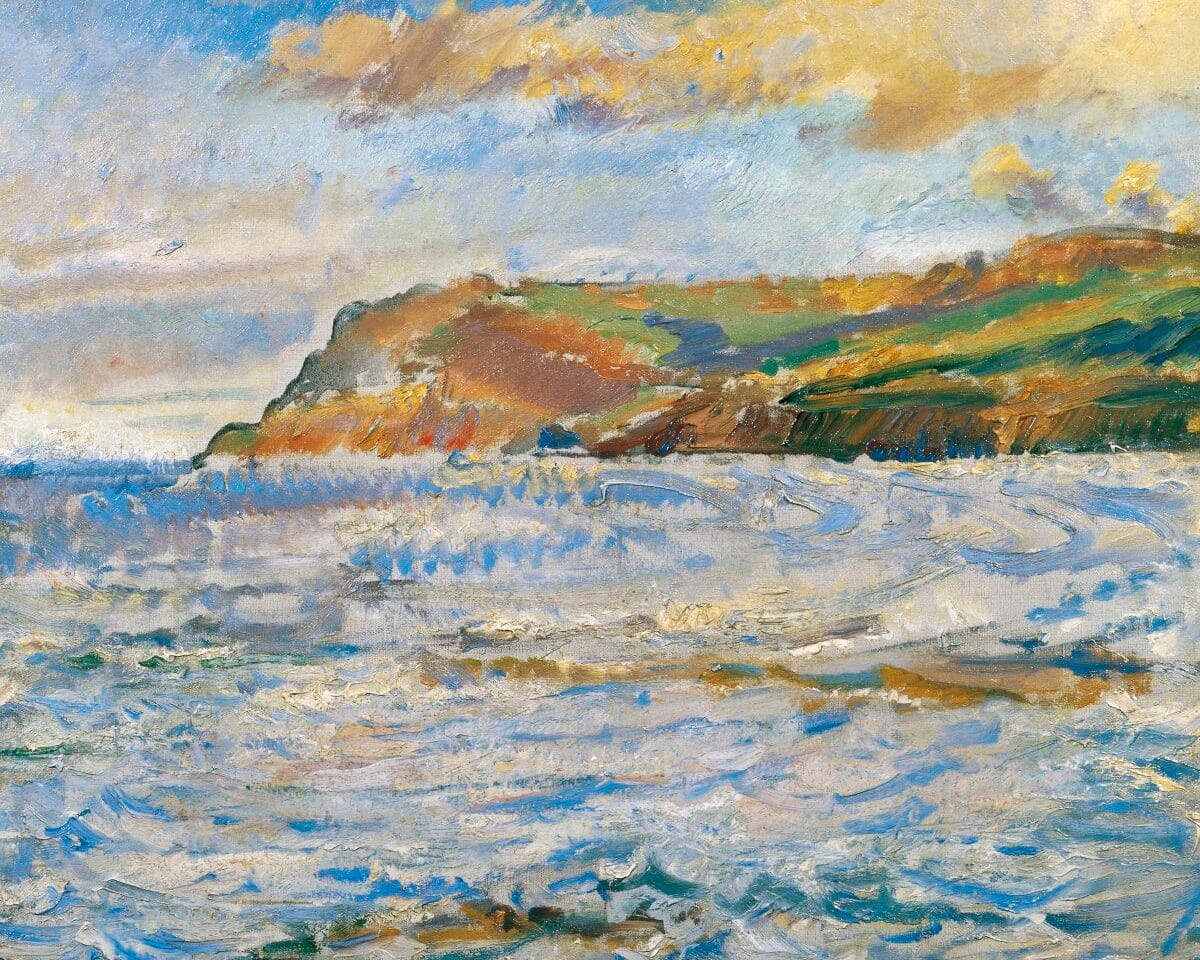
Imagen: A June Evening, óleo sobre lienzo de Dame Ethel Walker, 1921
Todos los caminos de nuestro barrio eran animados y acogedores, cada cual con sus propias cualidades agradables, pero este se veía diferente a los demás: insinuaba magistralmente un propósito serio que te impulsaba con una extraña elevación del corazón. Los otros lo tentaban a uno principalmente con sus tesoros de setos y zanjas; la sorpresa cautivadora de los primeros jaros, el correteo de un ratón de campo, el chapuzón de una rana, mientras las narices frías de nuestras hermanas bestias se le asomaban a uno entre las puertas o algún hueco. Un desocupado habrías tenido que ser para haber escogido uno de ellos; tantas eran las pequeñas manos que salían por todos lados a detenerlo a uno. Pero este otro era de una naturaleza más severa que, incluso al dejar atrás los setos y bancos de tierra mientras avanzaba en línea recta de lleno a las colinas abiertas, parecía declarar su desprecio por los adornos adventicios para atraer a los frívolos. Cuando me pesaban los sentimientos de injusticia o decepción, y la oscuridad reinaba en mi fuero interno, como en este preciso día, el camino singular era mi elección para ese paseo, cuando alguna tarde le daba la espalda a un mundo que sin más se había declarado en mi contra.
Los niños le decíamos «El Camino de los Caballeros» por una corazonada de que sería en este sendero por donde, si vinieran de algún lado, podríamos ver un día a Lancelot y a sus compañeros paseando en sus grandiosos caballos de guerra, en el caso de que alguno de su valiente compaña todavía estuviera vivo en escondrijos y lugares inexplorados. Los adultos a veces hablaban de ella como la «Senda de los Peregrinos», pero nunca supe mucho de peregrinos, excepto de Walter en la leyenda de Horselberg. A veces lo veía, saliendo de entre los matorrales con ojos demacrados, y llamando a los peregrinos mientras se apuraban en su desesperada marcha a la Ciudad Santa, donde la paz y la redención les esperaban. «Todos los caminos conducen a Roma», le escuché a alguien una vez. Me tomé el comentario muy en serio, por supuesto, y le di vueltas en mi mente muchos días. Debe haber habido algún error, concluí al final, pero intuía que aquello era verdad para al menos uno de esos caminos. Y mi creencia quedó confirmada por algo que se le escapó a la señorita Smedley durante una clase de historia sobre un camino extraño que pasaba justo por la mitad de Inglaterra hasta llegar a la costa, y luego seguía en Francia, al otro lado, y así sin desviarse, entre las ciudades y los viñedos, desde las nubladas Tierras Altas de Escocia a La Ciudad Eterna. Sin comprobación, cualquier cosa dicha por la señorita Smedley usualmente encontraba oídos incrédulos; pero esta vez, con el camino mismo como evidencia, parecía, por una vez, de alguna forma, que se había topado con la verdad.
¡Roma! Era fascinante pensar que estaba al otro extremo de esta cinta blanca que se desenrollaba desde mis pies por sobre las lejanas colinas. No era tan ignorante como para imaginar que podía llegar esa tarde, pero algún día, pensaba, si las cosas seguían siendo tan incómodas como hasta entonces, algún día, cuando la tía Eliza se hubiera de ir de visita, veríamos…
Intenté imaginarme cómo sería cuando llegara allá. El Coliseo lo conocía, claro, de un grabado de madera en el libro de historia: así que, para empezar, lo imaginaba justo en el medio. Lo demás lo recreaba a partir del pueblito comercial gris donde dos veces al año íbamos a que nos cortaran el pelo; por lo que, como resultado, al anfiteatro de Vespasiano se llegaba por unas pequeñas calles lodosas; en ellas, el León Rojo y el Jabalí Azul, con un anuncio de cerveza en sus fachadas y «Sala Comercial» en sus ventanas; la casa del doctor, de sólidos ladrillos rojos, y la fachada de la Nueva Capilla Wesleyana, que nos parecía bonita, eran los ornamentos arquitectónicos principales: mientras que el populacho romano andaba de aquí para allá con sus guardapolvos y pantalones de pana, retorciendo las colas de los terneros romanos e invitándose entre ellos a beber cerveza en la musical Wessex. De Roma seguí a otras ciudades poco conocidas, como Damasco, Brighton (el ideal de la tía Eliza), Atenas y Glasgow, cuyas glorias cantaba el jardinero, pero había algo particularmente igual en mi concepción de todas ellas: que esa capilla wesleyana seguía apareciendo en todas partes. Era más fácil ir construyendo esas ciudades de ensueño donde no se imponía ninguna limitación, y uno era el único arquitecto con carta blanca. A lo largo de una exquisita calle de palacios construidos con nubes, andaba yo paseándome mentalmente cuando me encontré con el Artista.
Estaba sentado trabajando a la orilla del camino, en un punto en el que los frescos espacios largos de las colinas, llenas de juníperos, se extendían majestuosamente hacia el oeste. Sus atributos lo delataban como alguien de la tribu de los artistas: además, llevaba puestos unos pantalones bombachos como yo, un atuendo exclusivo, lo sabía, de niños y artistas. Entendía que no debía molestarlo con preguntas ni mirar por encima de su hombro o respirar en su oído, lo que no les gustaba a los de este genus irritabile, pero no había nada sobre quedarse mirando en mi código de instrucciones, cosa de alguna forma pasada por alto. Así que, acurrucándome en el pasto, me dediqué a absorber cada detalle con pasión. Al cabo de cinco minutos no había un botón en él que no conociera al dedillo, y el portador mismo de ese vestido hecho en casa estaba menos familiarizado con su patrón que yo. En algún momento, levantó la mirada, asintió, sacó a medias su bolsa de tabaco mecánicamente, o eso parecía; luego, la volvió a meter en su bolsillo, continuó su trabajo, y yo mi fotografía mental.
Después de otros cinco minutos más o menos, dijo sin voltearme a mirar:
—Hace una linda tarde, ¿vas lejos hoy?
—No, hoy solo llego hasta aquí —respondí—. ESTABA pensando en ir a Roma, pero lo dejaré para después.
—Un lindo lugar Roma —murmuró—. Te gustará.
Fue después de unos minutos que él añadió:
—Pero yo no iría justo ahora si fuera tú. Hace un calor tremendo.
—USTED no ha ido a Roma, ¿o sí? —pregunté.
—Desde luego —respondió brevemente—, vivo allá.
Aquello fue demasiado, con la boca abierta luchaba por entender el hecho de que estaba ahí hablando con alguien que vivía en Roma. Me quedé sin palabras. Además, tenía otras cosas por hacer. Diez minutos enteros había gastado examinándolo como a un extraño y artista, y ahora tenía que hacerlo todo de nuevo, desde la nueva perspectiva. Entonces empecé desde cero, desde la copa de su suave sombrero, bajando hasta sus robustos zapatos británicos, esta vez dándole el nuevo halo romano a todo. Al final pude decir:
—¿De veras vive allá? —sin dudar nunca de ello, pero queriendo que lo repitiera de nuevo.
—Bueno —dijo, ignorando amablemente la sutil grosería de mi pregunta—. Vivo ahí tanto como en cualquier otra parte, a veces como medio año. Tengo algo así como una cabaña allá. Deberías venir y verla un día.
—¿Pero usted vive en algún otro lugar también? —seguí, sintiendo la corriente prohibida de preguntas surgiendo dentro de mí.
—Ah, sí, por todos lados —fue su vaga respuesta—. Y tengo un lugarcito en algún lugar de Piccadilly.
—¿Dónde es eso? —pregunté.
—¿Dónde es qué? —dijo—. ¡Ah, Piccadilly! Queda en Londres.
—¿Tiene un jardín grande? —pregunté—. ¿Y cuántos cerdos tiene?
—No tengo ningún jardín —respondió con tristeza—, y no me dejan tener cerdos, aunque me muero por tenerlos. Es muy duro.
—¿Pero entonces qué hace todo el día? —grité—, ¿y a dónde va a jugar si no tiene jardín ni cerdos ni nada?
—Cuando quiero jugar —dijo seriamente—, tengo que ir a jugar en la calle, pero no es muy divertido, he de admitirlo. Aunque hay una cabra, no muy lejos, y a veces le hablo cuando me siento solo; pero es muy orgullosa.
—Las cabras SON orgullosas —admití—. Hay una que vive cerca de aquí y, si se le dice cualquier cosa, le saca a uno el aire de una embestida al estómago. ¿Sabe lo que se siente cuando alguien le pega en el estómago?
—Lo sé bien —respondió, en un tono melancólico, y siguió pintando.
—¿Y ha visitado otros lugares —continué poco después—, aparte de Roma y Piqui-como-se-llame?
—Un montón —dijo—. Soy una especie de Ulises, he visto hombres y ciudades, ya sabes. De hecho, el único lugar al que nunca pude ir fue a la Isla Afortunada.
Me empezaba a agradar este sujeto. Respondía a las preguntas de forma breve y concisa, y nunca trataba de ser chistoso. Sentía que podía hablarle con total intimidad.
—¿No le gustaría —pregunté— encontrar una ciudad sin una sola persona en absoluto?
Parecía perplejo.
—Me temo que no entiendo —dijo.
—Quiero decir —seguí entusiasta—, una ciudad en la que uno camine por sus puertas, y las tiendas estén llenas de cosas lindas, y las casas amuebladas con el mayor lujo posible, ¡y que no haya absolutamente nadie allí! Y que uno entre a las tiendas y tome lo que quiera, chocolates, lámparas mágicas, pelotas de goma, y no toque pagar nada. ¡Que uno escoja su propia casa y viva ahí y haga lo que quiera, y nunca se vaya a la cama a menos que quiera!
El artista dejó su pincel.
—Esa SERÍA una linda ciudad —dijo—. Mejor que Roma. No puedes hacer ese tipo de cosas en Roma… o en Piccadilly. Pero me temo que es uno de esos lugares a los que no he ido.
—E invitaría a sus amigos —seguí, emocionándome con el tema—, solo a los que de verdad le agradan, claro, y cada quien tendría su propia casa, habría muchas casas, y nada de familiares, a menos que prometieran ser agradables, y si no lo fueran, tendrían que irse.
—¿Entonces no tendrías ningún familiar? —dijo el artista—. Pues, tal vez tengas razón. Tenemos gustos en común por lo que veo.
—Yo invitaría a Harold —dije, reflexionando— y a Charlotte. Les fascinaría. Los demás se están volviendo viejos. Ah, y Martha. Invitaría a Martha, que cocine, lave y haga los quehaceres. Martha le caería bien. Ella es mucho mejor que la tía Eliza. Es mi ideal de una dama de verdad.
—Entonces seguro que me agradaría —respondió alegremente—, y cuando venga a, ¿cómo se llama tu ciudad? Nephelo… Algo. ¿Qué habías dicho?
—No… No sé —respondí tímidamente—. Me temo que no tiene nombre… aún.
El artista echó la mirada por encima de las colinas.
—«El poeta dice: ¡Querida ciudad de Cécrope!» —dijo suave para sí mismo— «¿y tú no dirás: ¡Querida ciudad de Zeus!?». Es de Marco Aurelio —prosiguió volviéndose a su trabajo—. No lo conoces, me imagino. Algún día lo conocerás.
—¿Quién es él? —pregunté.
—Ah, es alguien más que vivió en Roma —respondió, dando suaves pinceladas.
—¡Ay, no! —exclamé desconsoladamente—. ¡Parece que mucha gente vive en Roma, y yo nunca he estado allá! Igual creo que me gustaría más MI ciudad.
—A mí también —respondió con fervor—. Pero a Marco Aurelio no, ¿sabes?
—Entonces no lo invitaremos —dije—, ¿o sí?
—Yo no lo haré si no quieres —dijo. Aclarado el asunto, nos quedamos callados por un momento.
—¿Sabes? —dijo poco después—, me he cruzado con uno o dos sujetos de vez en cuando que han estado en una ciudad como la tuya, tal vez es la misma. No hablan mucho de ella, solo cosas sueltas, de tanto en tanto; pero de seguro han estado allá. No parece importarles nada en particular, y todo les da lo mismo, favorable o adverso, y tarde o temprano se escabullen y desaparecen, y nunca los vuelves a ver de nuevo. Se regresan, supongo.
—Claro —dije—, no veo para qué volvieron a sus hogares en primer lugar. Yo no lo haría, que le digan a uno que ha roto cosas cuando no ha sido el caso, y dejar de tomar el té con los sirvientes en la cocina, y no tener permitido que el perro duerma con uno. Pero he conocido gente, también, que ha ido allá.
El artista se quedó mirando, pero no de forma grosera.
—Bueno, pues ahí está Lancelot —continué—. El libro dice que se murió, pero de cierta forma nunca tuvo mucho sentido para mí. Simplemente se fue, como Arturo. Y Crusoe, cuando se cansó de llevar ropa y ser respetable. Y todos los caballeros buenos que uno ve en los cuentos que no se casan con la princesa, pues en los libros solo un hombre se casa, ¿ves? ¡Ahí estarán!
—Y a los que nunca les va bien —dijo—, que lo intentan como el resto, pero terminan eliminados, o de alguna forma fallan, o los derrumban, o los acaban en el combate cuerpo a cuerpo, y no consiguen princesa alguna, ni siquiera un reino de segunda, algunos de ellos estarán ahí, espero.
—Sí, si quiere —le respondí sin entenderlo por completo—, si son amigos suyos, los invitamos, claro.
—¡La pasaríamos muy bien! —dijo el artista, pensativo—. ¡Y cómo quedará fuera de sí el viejo Marco Aurelio!
Las sombras se alargaron inquietantes, una marea de bruma dorada inundaba la superficie verde y grisácea de las colinas, y el artista empezó a guardar sus utensilios, preparándose para irse. Me sentí decaído, teníamos que separarnos cuando me parecía que justo nos estábamos empezando a llevar tan bien. Entonces se puso de pie, era bien alto y recto, y la puesta de sol caía sobre su cabello y barba mientras estaba ahí parado, alzándose sobre mí. Me dio la mano como si fuera un igual.
—He disfrutado mucho nuestra conversación —dijo—. Fue un tema interesante el que empezaste, y no hemos desmenuzado ni la mitad. Nos veremos de nuevo, espero.
—Claro que nos volveremos a ver —respondí, sorprendido de que fuera a haber duda alguna al respecto.
—¿En Roma, tal vez? —dijo él.
—Sí, en Roma —respondí— o en Piqui… El otro sitio, o en algún otro lugar.
—O… —dijo— en esa otra ciudad, cuando hayamos encontrado el camino hacia allá. Y estaré pendiente de tu llegada, y me llamarás de lejos tan pronto me veas. E iremos por la calle codo a codo, entraremos en las tiendas, y escogeré mi casa, y tú escogerás la tuya, y viviremos allí como príncipes y buenos compañeros.
—Ey, pero se quedará en mi casa, ¿no? —exclamé—. No le pediría eso a nadie más que a USTED.
Fingió pensarlo por un momento y dijo:
—¡Perfecto! Creo que lo dices en serio, así que iré y me quedaré contigo. No iré a ningún otro lugar, no importa qué tanto me lo pidan. Y me quedaré mucho tiempo y no te daré problemas.
Con este pacto nos despedimos, y me separé descorazonado del hombre que me había entendido para volver a la casa en donde no podía hacer nada bien. ¿Cómo es que todo parecía natural y sensato para él cuando estos tíos, vicarios y otros adultos lo tomaban por simples niñerías? Bueno, él me explicaría eso, y muchas otras cosas cuando nos volviéramos a ver. ¡El Camino de los Caballeros! ¡Cuánto consuelo me daba! ¿Acaso sería él uno de esos tantos caballeros desaparecidos que había estado buscando por tanto tiempo? Quizá la próxima vez lo vea con una armadura, ¿por qué no? Se vería bien con armadura, pensé. Procuraría llegar allí primero, y ver la luz del sol destellar y juguetear en su yelmo y escudo mientras se aproxima cabalgando por la Calle Principal de la Ciudad Dorada. Hasta entonces, solo queda encontrarla, cosa fácil.
The Roman Road
ALL the roads of our neighbourhood were cheerful and friendly, having each of them pleasant qualities of their own; but this one seemed different from the others in its masterful suggestion of a serious purpose, speeding you along with a strange uplifting of the heart. The others tempted chiefly with their treasures of hedge and ditch; the rapt surprise of the first lords-and-ladies, the rustle of a field-mouse, splash of a frog; while cool noses of brother-beasts were pushed at you through gate or gap. A loiterer you had need to be, did you choose one of them,—so many were the tiny hands thrust out to detain you, from this side and that. But this other was of a sterner sort, and even in its shedding off of bank and hedgerow as it marched straight and full for the open downs, it seemed to declare its contempt for adventitious trappings to catch the shallow-pated. When the sense of injustice or disappointment was heavy on me, and things were very black within, as on this particular day, the road of character was my choice for that solitary ramble, when I turned my back for an afternoon on a world that had unaccountably declared itself against me.
“The Knights’ Road,” we children had named it, from a sort of feeling that, if from any quarter at all, it would be down this track we might some day see Lancelot and his peers come pacing on their great war-horses,—supposing that any of the stout band still survived, in nooks and unexplored places. Grown-up people sometimes spoke of it as the “Pilgrims’ Way”; but I didn’t know much about pilgrims,—except Walter in the Horselberg story. Him I sometimes saw, breaking with haggard eyes out of yonder copse, and calling to the pilgrims as they hurried along on their desperate march to the Holy City, where peace and pardon were awaiting them. “All roads lead to Rome,” I had once heard somebody say; and I had taken the remark very seriously, of course, and puzzled over it many days. There must have been some mistake, I concluded at last; but of one road at least I intuitively felt it to be true. And my belief was clinched by something that fell from Miss Smedley during a history lesson, about a strange road that ran right down the middle of England till it reached the coast, and then began again in France, just opposite, and so on undeviating, through city and vineyard, right from the misty Highlands to the Eternal City. Uncorroborated, any statement of Miss Smedley’s usually fell on incredulous ears; but here, with the road itself in evidence, she seemed, once, in a way, to have strayed into truth.
Rome! It was fascinating to think that it lay at the other end of this white ribbon that rolled itself off from my feet over the distant downs. I was not quite so uninstructed as to imagine l could reach it that afternoon; but some day, I thought, if things went on being as unpleasant as they were now,—some day, when Aunt Eliza had gone on a visit,—we would see.
I tried to imagine what it would be like when I got there. The Coliseum I knew, of course, from a woodcut in the history-book: so to begin with I plumped that down in the middle. The rest had to be patched up from the little grey market-town where twice a year we went to have our hair cut; hence, in the result, Vespasian’s amphitheatre was approached by muddy little streets, wherein the Red Lion and the Blue Boar, with Somebody’s Entire along their front, and “Commercial Room” on their windows; the doctor’s house, of substantial red-brick; and the facade of the New Wesleyan Chapel, which we thought very fine, were the chief architectural ornaments: while the Roman populace pottered about in smocks and corduroys, twisting the tails of Roman calves and inviting each other to beer in musical Wessex. From Rome I drifted on to other cities, dimly heard of—Damascus, Brighton (Aunt Eliza’s ideal), Athens, and Glasgow, whose glories the gardener sang; but there was a certain sameness in my conception of all of them: that Wesleyan chapel would keep cropping up everywhere. It was easier to go a-building among those dream-cities where no limitations were imposed, and one was sole architect, with a free hand. Down a delectable street of cloud-built palaces I was mentally pacing, when I happened upon the Artist.
He was seated at work by the roadside, at a point whence the cool large spaces of the downs, juniper-studded, swept grandly westwards. His attributes proclaimed him of the artist tribe: besides, he wore knickerbockers like myself,—a garb confined, I was aware, to boys and artists. I knew I was not to bother him with questions, nor look over his shoulder and breathe in his ear—they didn’t like it, this genus irritabile; but there was nothing about staring in my code of instructions, the point having somehow been overlooked: so, squatting down on the grass, I devoted myself to a passionate absorbing of every detail. At the end of five minutes there was not a button on him that I could not have passed an examination in; and the wearer himself of that homespun suit was probably less familiar with its pattern and texture than I was. Once he looked up, nodded, half held out his tobacco pouch,—mechanically, as it were,—then, returning it to his pocket, resumed his work, and I my mental photography.
After another five minutes or so had passed he remarked, without looking my way: “Fine afternoon we’re having: going far to-day?”
“No, I’m not going any farther than this,” I replied; “I WAS thinking of going on to Rome but I’ve put it off.”
“Pleasant place, Rome,” he murmured; “you’ll like it.” It was some minutes later that he added: “But I wouldn’t go just now, if I were you,—too jolly hot.”
“YOU haven’t been to Rome, have you?” I inquired.
“Rather,” he replied, briefly; “I live there.”
This was too much, and my jaw dropped as I struggled to grasp the fact that I was sitting there talking to a fellow who lived in Rome. Speech was out of the question: besides, I had other things to do. Ten solid minutes had I already spent in an examination of him as a mere stranger and artist; and now the whole thing had to be done over again, from the changed point of view. So I began afresh, at the crown of his soft hat, and worked down to his solid British shoes, this time investing everything with the new Roman halo; and at last I managed to get out: “But you don’t really live there, do you?” never doubting the fact, but wanting to hear it repeated.
“Well,” he said, good-naturedly overlooking the slight rudeness of my query, “I live there as much as l live anywhere,—about half the year sometimes. I’ve got a sort of a shanty there. You must come and see it some day.”
“But do you live anywhere else as well?” I went on, feeling the forbidden tide of questions surging up within me.
“O yes, all over the place,” was his vague reply. “And I’ve got a diggings somewhere off Piccadilly.”
“Where’s that?” I inquired.
“Where’s what?” said he. “Oh, Piccadilly! It’s in London.”
“Have you a large garden?” I asked; “and how many pigs have you got?”
“I’ve no garden at all,” he replied, sadly, “and they don’t allow me to keep pigs, though I’d like to, awfully. It’s very hard.”
“But what do you do all day, then,” I cried, “and where do you go and play, without any garden, or pigs, or things?”
“When I want to play,” he said, gravely, “I have to go and play in the street; but it’s poor fun, I grant you. There’s a goat, though, not far off, and sometimes I talk to him when I’m feeling lonely; but he’s very proud.”
“Goats ARE proud,” I admitted. “There’s one lives near here, and if you say anything to him at all, he hits you in the wind with his head. You know what it feels like when a fellow hits you in the wind?”
“I do, well,” he replied, in a tone of proper melancholy, and painted on.
“And have you been to any other places,” I began again, presently, “besides Rome and Piccy-what’s-his-name?
“Heaps,” he said. “I’m a sort of Ulysses—seen men and cities, you know. In fact, about the only place I never got to was the Fortunate Island.”
I began to like this man. He answered your questions briefly and to the point, and never tried to be funny. I felt I could be confidential with him.
“Wouldn’t you like,” I inquired, “to find a city without any people in it at all?”
He looked puzzled. “I’m afraid I don’t quite understand,” said he.
“I mean,” I went on eagerly, “a city where you walk in at the gates, and the shops are all full of beautiful things, and the houses furnished as grand as can be, and there isn’t anybody there whatever! And you go into the shops, and take anything you want— chocolates and magic lanterns and injirubber balls—and there’s nothing to pay; and you choose your own house and live there and do just as you like, and never go to bed unless you want to!”
The artist laid down his brush. “That WOULD be a nice city,” he said. “Better than Rome. You can’t do that sort of thing in Rome,—or in Piccadilly either. But I fear it’s one of the places I’ve never been to.”
“And you’d ask your friends,” I went on, warming to my subject,—“only those you really like, of course,—and they’d each have a house to themselves,—there’d be lots of houses,—and no relations at all, unless they promised they’d be pleasant, and if they weren’t they’d have to go.”
“So you wouldn’t have any relations?” said the artist. “Well, perhaps you’re right. We have tastes in common, I see.”
I’d have Harold,” I said, reflectively, “and Charlotte. They’d like it awfully. The others are getting too old. Oh, and Martha—I’d have Martha, to cook and wash up and do things. You’d like Martha. She’s ever so much nicer than Aunt Eliza. She’s my idea of a real lady.”
“Then I’m sure I should like her,” he replied, heartily, “and when I come to—what do you call this city of yours? Nephelo—something, did you say?”
“I—I don’t know,” I replied, timidly. “I’m afraid it hasn’t got a name—yet.”
The artist gazed out over the downs. “’The poet says, dear city of Cecrops;’” he said, softly, to himself, “’and wilt not thou say, dear city of Zeus?’ That’s from Marcus Aurelius,” he went on, turning again to his work. “You don’t know him, I suppose; you will some day.”
“Who’s he?” I inquired.
“Oh, just another fellow who lived in Rome,” he replied, dabbing away.
“O dear!” I cried, disconsolately. “What a lot of people seem to live at Rome, and I’ve never even been there! But I think I’d like MY city best.”
“And so would I,” he replied with unction. “But Marcus Aurelius wouldn’t, you know.”
“Then we won’t invite him,” I said, “will we?”
“I won’t if you won’t,” said he. And that point being settled, we were silent for a while.
“Do you know,” he said, presently, “I’ve met one or two fellows from time to time who have been to a city like yours,—perhaps it was the same one. They won’t talk much about it—only broken hints, now and then; but they’ve been there sure enough. They don’t seem to care about anything in particular—and every thing’s the same to them, rough or smooth; and sooner or later they slip off and disappear; and you never see them again. Gone back, I suppose.”
“Of course,” said I. “Don’t see what they ever came away for; I wouldn’t,—to be told you’ve broken things when you haven’t, and stopped having tea with the servants in the kitchen, and not allowed to have a dog to sleep with you. But I’ve known people, too, who’ve gone there.”
The artist stared, but without incivility.
“Well, there’s Lancelot,” I went on. “The book says he died, but it never seemed to read right, somehow. He just went away, like Arthur. And Crusoe, when he got tired of wearing clothes and being respectable. And all the nice men in the stones who don’t marry the Princess, ‘cos only one man ever gets married in a book, you know. They’ll be there!”
“And the men who never come off,” he said, “who try like the rest, but get knocked out, or somehow miss,—or break down or get bowled over in the melee,—and get no Princess, nor even a second-class kingdom,—some of them’ll be there, I hope?”
“Yes, if you like,” I replied, not quite understanding him; “if they’re friends of yours, we’ll ask ‘em, of course.”
“What a time we shall have!” said the artist, reflectively; “and how shocked old Marcus Aurelius will be!”
The shadows had lengthened uncannily, a tide of golden haze was flooding the grey-green surface of the downs, and the artist began to put his traps together, preparatory to a move. I felt very low; we would have to part, it seemed, just as we were getting on so well together. Then he stood up, and he was very straight and tall, and the sunset was in his hair and beard as he stood there, high over me. He took my hand like an equal. “I’ve enjoyed our conversation very much,” he said. “That was an interesting subject you started, and we haven’t half exhausted it. We shall meet again, I hope.”
“Of course we shall,” I replied, surprised that there should be any doubt about it.
“In Rome, perhaps?” said he.
“Yes, in Rome,” I answered, “or Piccy-the-other-place, or somewhere.”
“Or else,” said he, “in that other city,—when we’ve found the way there. And I’ll look out for you, and you’ll sing out as soon as you see me. And we’ll go down the street arm-in- arm, and into all the shops, and then I’ll choose my house, and you’ll choose your house, and we’ll live there like princes and good fellows.”
“Oh, but you’ll stay in my house, won’t you?” I cried; “wouldn’t ask everybody; but I’ll ask YOU.”
He affected to consider a moment; then “Right!” he said: “I believe you mean it, and I WILL come and stay with you. I won’t go to anybody else, if they ask me ever so much. And I’ll stay quite a long time, too, and I won’t be any trouble.”
Upon this compact we parted, and I went down-heartedly from the man who understood me, back to the house where I never could do anything right. How was it that everything seemed natural and sensible to him, which these uncles, vicars, and other grown-up men took for the merest tomfoolery? Well, he would explain this, and many another thing, when we met again. The Knights’ Road! How it always brought consolation! Was he possibly one of those vanished knights I had been looking for so long? Perhaps he would be in armour next time,—why not? He would look well in armour, I thought. And I would take care to get there first, and see the sunlight flash and play on his helmet and shield, as he rode up the High Street of the Golden City. Meantime, there only remained the finding it,—an easy matter.
(Tomado de https://www.gutenberg.org/files/32501/32501-h/32501-h.htm#Page_161)
The Roman Road
ALL the roads of our neighbourhood were cheerful and friendly, having each of them pleasant qualities of their own; but this one seemed different from the others in its masterful suggestion of a serious purpose, speeding you along with a strange uplifting of the heart. The others tempted chiefly with their treasures of hedge and ditch; the rapt surprise of the first lords-and-ladies, the rustle of a field-mouse, splash of a frog; while cool noses of brother-beasts were pushed at you through gate or gap. A loiterer you had need to be, did you choose one of them,—so many were the tiny hands thrust out to detain you, from this side and that. But this other was of a sterner sort, and even in its shedding off of bank and hedgerow as it marched straight and full for the open downs, it seemed to declare its contempt for adventitious trappings to catch the shallow-pated. When the sense of injustice or disappointment was heavy on me, and things were very black within, as on this particular day, the road of character was my choice for that solitary ramble, when I turned my back for an afternoon on a world that had unaccountably declared itself against me.
“The Knights’ Road,” we children had named it, from a sort of feeling that, if from any quarter at all, it would be down this track we might some day see Lancelot and his peers come pacing on their great war-horses,—supposing that any of the stout band still survived, in nooks and unexplored places. Grown-up people sometimes spoke of it as the “Pilgrims’ Way”; but I didn’t know much about pilgrims,—except Walter in the Horselberg story. Him I sometimes saw, breaking with haggard eyes out of yonder copse, and calling to the pilgrims as they hurried along on their desperate march to the Holy City, where peace and pardon were awaiting them. “All roads lead to Rome,” I had once heard somebody say; and I had taken the remark very seriously, of course, and puzzled over it many days. There must have been some mistake, I concluded at last; but of one road at least I intuitively felt it to be true. And my belief was clinched by something that fell from Miss Smedley during a history lesson, about a strange road that ran right down the middle of England till it reached the coast, and then began again in France, just opposite, and so on undeviating, through city and vineyard, right from the misty Highlands to the Eternal City. Uncorroborated, any statement of Miss Smedley’s usually fell on incredulous ears; but here, with the road itself in evidence, she seemed, once, in a way, to have strayed into truth.
Rome! It was fascinating to think that it lay at the other end of this white ribbon that rolled itself off from my feet over the distant downs. I was not quite so uninstructed as to imagine l could reach it that afternoon; but some day, I thought, if things went on being as unpleasant as they were now,—some day, when Aunt Eliza had gone on a visit,—we would see.
I tried to imagine what it would be like when I got there. The Coliseum I knew, of course, from a woodcut in the history-book: so to begin with I plumped that down in the middle. The rest had to be patched up from the little grey market-town where twice a year we went to have our hair cut; hence, in the result, Vespasian’s amphitheatre was approached by muddy little streets, wherein the Red Lion and the Blue Boar, with Somebody’s Entire along their front, and “Commercial Room” on their windows; the doctor’s house, of substantial red-brick; and the facade of the New Wesleyan Chapel, which we thought very fine, were the chief architectural ornaments: while the Roman populace pottered about in smocks and corduroys, twisting the tails of Roman calves and inviting each other to beer in musical Wessex. From Rome I drifted on to other cities, dimly heard of—Damascus, Brighton (Aunt Eliza’s ideal), Athens, and Glasgow, whose glories the gardener sang; but there was a certain sameness in my conception of all of them: that Wesleyan chapel would keep cropping up everywhere. It was easier to go a-building among those dream-cities where no limitations were imposed, and one was sole architect, with a free hand. Down a delectable street of cloud-built palaces I was mentally pacing, when I happened upon the Artist.
He was seated at work by the roadside, at a point whence the cool large spaces of the downs, juniper-studded, swept grandly westwards. His attributes proclaimed him of the artist tribe: besides, he wore knickerbockers like myself,—a garb confined, I was aware, to boys and artists. I knew I was not to bother him with questions, nor look over his shoulder and breathe in his ear—they didn’t like it, this genus irritabile; but there was nothing about staring in my code of instructions, the point having somehow been overlooked: so, squatting down on the grass, I devoted myself to a passionate absorbing of every detail. At the end of five minutes there was not a button on him that I could not have passed an examination in; and the wearer himself of that homespun suit was probably less familiar with its pattern and texture than I was. Once he looked up, nodded, half held out his tobacco pouch,—mechanically, as it were,—then, returning it to his pocket, resumed his work, and I my mental photography.
After another five minutes or so had passed he remarked, without looking my way: “Fine afternoon we’re having: going far to-day?”
“No, I’m not going any farther than this,” I replied; “I WAS thinking of going on to Rome but I’ve put it off.”
“Pleasant place, Rome,” he murmured; “you’ll like it.” It was some minutes later that he added: “But I wouldn’t go just now, if I were you,—too jolly hot.”
“YOU haven’t been to Rome, have you?” I inquired.
“Rather,” he replied, briefly; “I live there.”
This was too much, and my jaw dropped as I struggled to grasp the fact that I was sitting there talking to a fellow who lived in Rome. Speech was out of the question: besides, I had other things to do. Ten solid minutes had I already spent in an examination of him as a mere stranger and artist; and now the whole thing had to be done over again, from the changed point of view. So I began afresh, at the crown of his soft hat, and worked down to his solid British shoes, this time investing everything with the new Roman halo; and at last I managed to get out: “But you don’t really live there, do you?” never doubting the fact, but wanting to hear it repeated.
“Well,” he said, good-naturedly overlooking the slight rudeness of my query, “I live there as much as l live anywhere,—about half the year sometimes. I’ve got a sort of a shanty there. You must come and see it some day.”
“But do you live anywhere else as well?” I went on, feeling the forbidden tide of questions surging up within me.
“O yes, all over the place,” was his vague reply. “And I’ve got a diggings somewhere off Piccadilly.”
“Where’s that?” I inquired.
“Where’s what?” said he. “Oh, Piccadilly! It’s in London.”
“Have you a large garden?” I asked; “and how many pigs have you got?”
“I’ve no garden at all,” he replied, sadly, “and they don’t allow me to keep pigs, though I’d like to, awfully. It’s very hard.”
“But what do you do all day, then,” I cried, “and where do you go and play, without any garden, or pigs, or things?”
“When I want to play,” he said, gravely, “I have to go and play in the street; but it’s poor fun, I grant you. There’s a goat, though, not far off, and sometimes I talk to him when I’m feeling lonely; but he’s very proud.”
“Goats ARE proud,” I admitted. “There’s one lives near here, and if you say anything to him at all, he hits you in the wind with his head. You know what it feels like when a fellow hits you in the wind?”
“I do, well,” he replied, in a tone of proper melancholy, and painted on.
“And have you been to any other places,” I began again, presently, “besides Rome and Piccy-what’s-his-name?
“Heaps,” he said. “I’m a sort of Ulysses—seen men and cities, you know. In fact, about the only place I never got to was the Fortunate Island.”
I began to like this man. He answered your questions briefly and to the point, and never tried to be funny. I felt I could be confidential with him.
“Wouldn’t you like,” I inquired, “to find a city without any people in it at all?”
He looked puzzled. “I’m afraid I don’t quite understand,” said he.
“I mean,” I went on eagerly, “a city where you walk in at the gates, and the shops are all full of beautiful things, and the houses furnished as grand as can be, and there isn’t anybody there whatever! And you go into the shops, and take anything you want— chocolates and magic lanterns and injirubber balls—and there’s nothing to pay; and you choose your own house and live there and do just as you like, and never go to bed unless you want to!”
The artist laid down his brush. “That WOULD be a nice city,” he said. “Better than Rome. You can’t do that sort of thing in Rome,—or in Piccadilly either. But I fear it’s one of the places I’ve never been to.”
“And you’d ask your friends,” I went on, warming to my subject,—“only those you really like, of course,—and they’d each have a house to themselves,—there’d be lots of houses,—and no relations at all, unless they promised they’d be pleasant, and if they weren’t they’d have to go.”
“So you wouldn’t have any relations?” said the artist. “Well, perhaps you’re right. We have tastes in common, I see.”
I’d have Harold,” I said, reflectively, “and Charlotte. They’d like it awfully. The others are getting too old. Oh, and Martha—I’d have Martha, to cook and wash up and do things. You’d like Martha. She’s ever so much nicer than Aunt Eliza. She’s my idea of a real lady.”
“Then I’m sure I should like her,” he replied, heartily, “and when I come to—what do you call this city of yours? Nephelo—something, did you say?”
“I—I don’t know,” I replied, timidly. “I’m afraid it hasn’t got a name—yet.”
The artist gazed out over the downs. “’The poet says, dear city of Cecrops;’” he said, softly, to himself, “’and wilt not thou say, dear city of Zeus?’ That’s from Marcus Aurelius,” he went on, turning again to his work. “You don’t know him, I suppose; you will some day.”
“Who’s he?” I inquired.
“Oh, just another fellow who lived in Rome,” he replied, dabbing away.
“O dear!” I cried, disconsolately. “What a lot of people seem to live at Rome, and I’ve never even been there! But I think I’d like MY city best.”
“And so would I,” he replied with unction. “But Marcus Aurelius wouldn’t, you know.”
“Then we won’t invite him,” I said, “will we?”
“I won’t if you won’t,” said he. And that point being settled, we were silent for a while.
“Do you know,” he said, presently, “I’ve met one or two fellows from time to time who have been to a city like yours,—perhaps it was the same one. They won’t talk much about it—only broken hints, now and then; but they’ve been there sure enough. They don’t seem to care about anything in particular—and every thing’s the same to them, rough or smooth; and sooner or later they slip off and disappear; and you never see them again. Gone back, I suppose.”
“Of course,” said I. “Don’t see what they ever came away for; I wouldn’t,—to be told you’ve broken things when you haven’t, and stopped having tea with the servants in the kitchen, and not allowed to have a dog to sleep with you. But I’ve known people, too, who’ve gone there.”
The artist stared, but without incivility.
“Well, there’s Lancelot,” I went on. “The book says he died, but it never seemed to read right, somehow. He just went away, like Arthur. And Crusoe, when he got tired of wearing clothes and being respectable. And all the nice men in the stones who don’t marry the Princess, ‘cos only one man ever gets married in a book, you know. They’ll be there!”
“And the men who never come off,” he said, “who try like the rest, but get knocked out, or somehow miss,—or break down or get bowled over in the melee,—and get no Princess, nor even a second-class kingdom,—some of them’ll be there, I hope?”
“Yes, if you like,” I replied, not quite understanding him; “if they’re friends of yours, we’ll ask ‘em, of course.”
“What a time we shall have!” said the artist, reflectively; “and how shocked old Marcus Aurelius will be!”
The shadows had lengthened uncannily, a tide of golden haze was flooding the grey-green surface of the downs, and the artist began to put his traps together, preparatory to a move. I felt very low; we would have to part, it seemed, just as we were getting on so well together. Then he stood up, and he was very straight and tall, and the sunset was in his hair and beard as he stood there, high over me. He took my hand like an equal. “I’ve enjoyed our conversation very much,” he said. “That was an interesting subject you started, and we haven’t half exhausted it. We shall meet again, I hope.”
“Of course we shall,” I replied, surprised that there should be any doubt about it.
“In Rome, perhaps?” said he.
“Yes, in Rome,” I answered, “or Piccy-the-other-place, or somewhere.”
“Or else,” said he, “in that other city,—when we’ve found the way there. And I’ll look out for you, and you’ll sing out as soon as you see me. And we’ll go down the street arm-in- arm, and into all the shops, and then I’ll choose my house, and you’ll choose your house, and we’ll live there like princes and good fellows.”
“Oh, but you’ll stay in my house, won’t you?” I cried; “wouldn’t ask everybody; but I’ll ask YOU.”
He affected to consider a moment; then “Right!” he said: “I believe you mean it, and I WILL come and stay with you. I won’t go to anybody else, if they ask me ever so much. And I’ll stay quite a long time, too, and I won’t be any trouble.”
Upon this compact we parted, and I went down-heartedly from the man who understood me, back to the house where I never could do anything right. How was it that everything seemed natural and sensible to him, which these uncles, vicars, and other grown-up men took for the merest tomfoolery? Well, he would explain this, and many another thing, when we met again. The Knights’ Road! How it always brought consolation! Was he possibly one of those vanished knights I had been looking for so long? Perhaps he would be in armour next time,—why not? He would look well in armour, I thought. And I would take care to get there first, and see the sunlight flash and play on his helmet and shield, as he rode up the High Street of the Golden City. Meantime, there only remained the finding it,—an easy matter.
El camino romano
Todos los caminos de nuestro barrio eran animados y acogedores, cada cual con sus propias cualidades agradables, pero este se veía diferente a los demás: insinuaba magistralmente un propósito serio que te impulsaba con una extraña elevación del corazón. Los otros lo tentaban a uno principalmente con sus tesoros de setos y zanjas; la sorpresa cautivadora de los primeros jaros, el correteo de un ratón de campo, el chapuzón de una rana, mientras las narices frías de nuestras hermanas bestias se le asomaban a uno entre las puertas o algún hueco. Un desocupado habrías tenido que ser para haber escogido uno de ellos; tantas eran las pequeñas manos que salían por todos lados a detenerlo a uno. Pero este otro era de una naturaleza más severa que, incluso al dejar atrás los setos y bancos de tierra mientras avanzaba en línea recta de lleno a las colinas abiertas, parecía declarar su desprecio por los adornos adventicios para atraer a los frívolos. Cuando me pesaban los sentimientos de injusticia o decepción, y la oscuridad reinaba en mi fuero interno, como en este preciso día, el camino singular era mi elección para ese paseo, cuando alguna tarde le daba la espalda a un mundo que sin más se había declarado en mi contra.
Los niños le decíamos «El Camino de los Caballeros» por una corazonada de que sería en este sendero por donde, si vinieran de algún lado, podríamos ver un día a Lancelot y a sus compañeros paseando en sus grandiosos caballos de guerra, en el caso de que alguno de su valiente compaña todavía estuviera vivo en escondrijos y lugares inexplorados. Los adultos a veces hablaban de ella como la «Senda de los Peregrinos», pero nunca supe mucho de peregrinos, excepto de Walter en la leyenda de Horselberg. A veces lo veía, saliendo de entre los matorrales con ojos demacrados, y llamando a los peregrinos mientras se apuraban en su desesperada marcha a la Ciudad Santa, donde la paz y la redención les esperaban. «Todos los caminos conducen a Roma», le escuché a alguien una vez. Me tomé el comentario muy en serio, por supuesto, y le di vueltas en mi mente muchos días. Debe haber habido algún error, concluí al final, pero intuía que aquello era verdad para al menos uno de esos caminos. Y mi creencia quedó confirmada por algo que se le escapó a la señorita Smedley durante una clase de historia sobre un camino extraño que pasaba justo por la mitad de Inglaterra hasta llegar a la costa, y luego seguía en Francia, al otro lado, y así sin desviarse, entre las ciudades y los viñedos, desde las nubladas Tierras Altas de Escocia a La Ciudad Eterna. Sin comprobación, cualquier cosa dicha por la señorita Smedley usualmente encontraba oídos incrédulos; pero esta vez, con el camino mismo como evidencia, parecía, por una vez, de alguna forma, que se había topado con la verdad.
¡Roma! Era fascinante pensar que estaba al otro extremo de esta cinta blanca que se desenrollaba desde mis pies por sobre las lejanas colinas. No era tan ignorante como para imaginar que podía llegar esa tarde, pero algún día, pensaba, si las cosas seguían siendo tan incómodas como hasta entonces, algún día, cuando la tía Eliza se hubiera de ir de visita, veríamos…
Intenté imaginarme cómo sería cuando llegara allá. El Coliseo lo conocía, claro, de un grabado de madera en el libro de historia: así que, para empezar, lo imaginaba justo en el medio. Lo demás lo recreaba a partir del pueblito comercial gris donde dos veces al año íbamos a que nos cortaran el pelo; por lo que, como resultado, al anfiteatro de Vespasiano se llegaba por unas pequeñas calles lodosas; en ellas, el León Rojo y el Jabalí Azul, con un anuncio de cerveza en sus fachadas y «Sala Comercial» en sus ventanas; la casa del doctor, de sólidos ladrillos rojos, y la fachada de la Nueva Capilla Wesleyana, que nos parecía bonita, eran los ornamentos arquitectónicos principales: mientras que el populacho romano andaba de aquí para allá con sus guardapolvos y pantalones de pana, retorciendo las colas de los terneros romanos e invitándose entre ellos a beber cerveza en la musical Wessex. De Roma seguí a otras ciudades poco conocidas, como Damasco, Brighton (el ideal de la tía Eliza), Atenas y Glasgow, cuyas glorias cantaba el jardinero, pero había algo particularmente igual en mi concepción de todas ellas: que esa capilla wesleyana seguía apareciendo en todas partes. Era más fácil ir construyendo esas ciudades de ensueño donde no se imponía ninguna limitación, y uno era el único arquitecto con carta blanca. A lo largo de una exquisita calle de palacios construidos con nubes, andaba yo paseándome mentalmente cuando me encontré con el Artista.
Estaba sentado trabajando a la orilla del camino, en un punto en el que los frescos espacios largos de las colinas, llenas de juníperos, se extendían majestuosamente hacia el oeste. Sus atributos lo delataban como alguien de la tribu de los artistas: además, llevaba puestos unos pantalones bombachos como yo, un atuendo exclusivo, lo sabía, de niños y artistas. Entendía que no debía molestarlo con preguntas ni mirar por encima de su hombro o respirar en su oído, lo que no les gustaba a los de este genus irritabile, pero no había nada sobre quedarse mirando en mi código de instrucciones, cosa de alguna forma pasada por alto. Así que, acurrucándome en el pasto, me dediqué a absorber cada detalle con pasión. Al cabo de cinco minutos no había un botón en él que no conociera al dedillo, y el portador mismo de ese vestido hecho en casa estaba menos familiarizado con su patrón que yo. En algún momento, levantó la mirada, asintió, sacó a medias su bolsa de tabaco mecánicamente, o eso parecía; luego, la volvió a meter en su bolsillo, continuó su trabajo, y yo mi fotografía mental.
Después de otros cinco minutos más o menos, dijo sin voltearme a mirar:
—Hace una linda tarde, ¿vas lejos hoy?
—No, hoy solo llego hasta aquí —respondí—. ESTABA pensando en ir a Roma, pero lo dejaré para después.
—Un lindo lugar Roma —murmuró—. Te gustará.
Fue después de unos minutos que él añadió:
—Pero yo no iría justo ahora si fuera tú. Hace un calor tremendo.
—USTED no ha ido a Roma, ¿o sí? —pregunté.
—Desde luego —respondió brevemente—, vivo allá.
Aquello fue demasiado, con la boca abierta luchaba por entender el hecho de que estaba ahí hablando con alguien que vivía en Roma. Me quedé sin palabras. Además, tenía otras cosas por hacer. Diez minutos enteros había gastado examinándolo como a un extraño y artista, y ahora tenía que hacerlo todo de nuevo, desde la nueva perspectiva. Entonces empecé desde cero, desde la copa de su suave sombrero, bajando hasta sus robustos zapatos británicos, esta vez dándole el nuevo halo romano a todo. Al final pude decir:
—¿De veras vive allá? —sin dudar nunca de ello, pero queriendo que lo repitiera de nuevo.
—Bueno —dijo, ignorando amablemente la sutil grosería de mi pregunta—. Vivo ahí tanto como en cualquier otra parte, a veces como medio año. Tengo algo así como una cabaña allá. Deberías venir y verla un día.
—¿Pero usted vive en algún otro lugar también? —seguí, sintiendo la corriente prohibida de preguntas surgiendo dentro de mí.
—Ah, sí, por todos lados —fue su vaga respuesta—. Y tengo un lugarcito en algún lugar de Piccadilly.
—¿Dónde es eso? —pregunté.
—¿Dónde es qué? —dijo—. ¡Ah, Piccadilly! Queda en Londres.
—¿Tiene un jardín grande? —pregunté—. ¿Y cuántos cerdos tiene?
—No tengo ningún jardín —respondió con tristeza—, y no me dejan tener cerdos, aunque me muero por tenerlos. Es muy duro.
—¿Pero entonces qué hace todo el día? —grité—, ¿y a dónde va a jugar si no tiene jardín ni cerdos ni nada?
—Cuando quiero jugar —dijo seriamente—, tengo que ir a jugar en la calle, pero no es muy divertido, he de admitirlo. Aunque hay una cabra, no muy lejos, y a veces le hablo cuando me siento solo; pero es muy orgullosa.
—Las cabras SON orgullosas —admití—. Hay una que vive cerca de aquí y, si se le dice cualquier cosa, le saca a uno el aire de una embestida al estómago. ¿Sabe lo que se siente cuando alguien le pega en el estómago?
—Lo sé bien —respondió, en un tono melancólico, y siguió pintando.
—¿Y ha visitado otros lugares —continué poco después—, aparte de Roma y Piqui-como-se-llame?
—Un montón —dijo—. Soy una especie de Ulises, he visto hombres y ciudades, ya sabes. De hecho, el único lugar al que nunca pude ir fue a la Isla Afortunada.
Me empezaba a agradar este sujeto. Respondía a las preguntas de forma breve y concisa, y nunca trataba de ser chistoso. Sentía que podía hablarle con total intimidad.
—¿No le gustaría —pregunté— encontrar una ciudad sin una sola persona en absoluto?
Parecía perplejo.
—Me temo que no entiendo —dijo.
—Quiero decir —seguí entusiasta—, una ciudad en la que uno camine por sus puertas, y las tiendas estén llenas de cosas lindas, y las casas amuebladas con el mayor lujo posible, ¡y que no haya absolutamente nadie allí! Y que uno entre a las tiendas y tome lo que quiera, chocolates, lámparas mágicas, pelotas de goma, y no toque pagar nada. ¡Que uno escoja su propia casa y viva ahí y haga lo que quiera, y nunca se vaya a la cama a menos que quiera!
El artista dejó su pincel.
—Esa SERÍA una linda ciudad —dijo—. Mejor que Roma. No puedes hacer ese tipo de cosas en Roma… o en Piccadilly. Pero me temo que es uno de esos lugares a los que no he ido.
—E invitaría a sus amigos —seguí, emocionándome con el tema—, solo a los que de verdad le agradan, claro, y cada quien tendría su propia casa, habría muchas casas, y nada de familiares, a menos que prometieran ser agradables, y si no lo fueran, tendrían que irse.
—¿Entonces no tendrías ningún familiar? —dijo el artista—. Pues, tal vez tengas razón. Tenemos gustos en común por lo que veo.
—Yo invitaría a Harold —dije, reflexionando— y a Charlotte. Les fascinaría. Los demás se están volviendo viejos. Ah, y Martha. Invitaría a Martha, que cocine, lave y haga los quehaceres. Martha le caería bien. Ella es mucho mejor que la tía Eliza. Es mi ideal de una dama de verdad.
—Entonces seguro que me agradaría —respondió alegremente—, y cuando venga a, ¿cómo se llama tu ciudad? Nephelo… Algo. ¿Qué habías dicho?
—No… No sé —respondí tímidamente—. Me temo que no tiene nombre… aún.
El artista echó la mirada por encima de las colinas.
—«El poeta dice: ¡Querida ciudad de Cécrope!» —dijo suave para sí mismo— «¿y tú no dirás: ¡Querida ciudad de Zeus!?». Es de Marco Aurelio —prosiguió volviéndose a su trabajo—. No lo conoces, me imagino. Algún día lo conocerás.
—¿Quién es él? —pregunté.
—Ah, es alguien más que vivió en Roma —respondió, dando suaves pinceladas.
—¡Ay, no! —exclamé desconsoladamente—. ¡Parece que mucha gente vive en Roma, y yo nunca he estado allá! Igual creo que me gustaría más MI ciudad.
—A mí también —respondió con fervor—. Pero a Marco Aurelio no, ¿sabes?
—Entonces no lo invitaremos —dije—, ¿o sí?
—Yo no lo haré si no quieres —dijo. Aclarado el asunto, nos quedamos callados por un momento.
—¿Sabes? —dijo poco después—, me he cruzado con uno o dos sujetos de vez en cuando que han estado en una ciudad como la tuya, tal vez es la misma. No hablan mucho de ella, solo cosas sueltas, de tanto en tanto; pero de seguro han estado allá. No parece importarles nada en particular, y todo les da lo mismo, favorable o adverso, y tarde o temprano se escabullen y desaparecen, y nunca los vuelves a ver de nuevo. Se regresan, supongo.
—Claro —dije—, no veo para qué volvieron a sus hogares en primer lugar. Yo no lo haría, que le digan a uno que ha roto cosas cuando no ha sido el caso, y dejar de tomar el té con los sirvientes en la cocina, y no tener permitido que el perro duerma con uno. Pero he conocido gente, también, que ha ido allá.
El artista se quedó mirando, pero no de forma grosera.
—Bueno, pues ahí está Lancelot —continué—. El libro dice que se murió, pero de cierta forma nunca tuvo mucho sentido para mí. Simplemente se fue, como Arturo. Y Crusoe, cuando se cansó de llevar ropa y ser respetable. Y todos los caballeros buenos que uno ve en los cuentos que no se casan con la princesa, pues en los libros solo un hombre se casa, ¿ves? ¡Ahí estarán!
—Y a los que nunca les va bien —dijo—, que lo intentan como el resto, pero terminan eliminados, o de alguna forma fallan, o los derrumban, o los acaban en el combate cuerpo a cuerpo, y no consiguen princesa alguna, ni siquiera un reino de segunda, algunos de ellos estarán ahí, espero.
—Sí, si quiere —le respondí sin entenderlo por completo—, si son amigos suyos, los invitamos, claro.
—¡La pasaríamos muy bien! —dijo el artista, pensativo—. ¡Y cómo quedará fuera de sí el viejo Marco Aurelio!
Las sombras se alargaron inquietantes, una marea de bruma dorada inundaba la superficie verde y grisácea de las colinas, y el artista empezó a guardar sus utensilios, preparándose para irse. Me sentí decaído, teníamos que separarnos cuando me parecía que justo nos estábamos empezando a llevar tan bien. Entonces se puso de pie, era bien alto y recto, y la puesta de sol caía sobre su cabello y barba mientras estaba ahí parado, alzándose sobre mí. Me dio la mano como si fuera un igual.
—He disfrutado mucho nuestra conversación —dijo—. Fue un tema interesante el que empezaste, y no hemos desmenuzado ni la mitad. Nos veremos de nuevo, espero.
—Claro que nos volveremos a ver —respondí, sorprendido de que fuera a haber duda alguna al respecto.
—¿En Roma, tal vez? —dijo él.
—Sí, en Roma —respondí— o en Piqui… El otro sitio, o en algún otro lugar.
—O… —dijo— en esa otra ciudad, cuando hayamos encontrado el camino hacia allá. Y estaré pendiente de tu llegada, y me llamarás de lejos tan pronto me veas. E iremos por la calle codo a codo, entraremos en las tiendas, y escogeré mi casa, y tú escogerás la tuya, y viviremos allí como príncipes y buenos compañeros.
—Ey, pero se quedará en mi casa, ¿no? —exclamé—. No le pediría eso a nadie más que a USTED.
Fingió pensarlo por un momento y dijo:
—¡Perfecto! Creo que lo dices en serio, así que iré y me quedaré contigo. No iré a ningún otro lugar, no importa qué tanto me lo pidan. Y me quedaré mucho tiempo y no te daré problemas.
Con este pacto nos despedimos, y me separé descorazonado del hombre que me había entendido para volver a la casa en donde no podía hacer nada bien. ¿Cómo es que todo parecía natural y sensato para él cuando estos tíos, vicarios y otros adultos lo tomaban por simples niñerías? Bueno, él me explicaría eso, y muchas otras cosas cuando nos volviéramos a ver. ¡El Camino de los Caballeros! ¡Cuánto consuelo me daba! ¿Acaso sería él uno de esos tantos caballeros desaparecidos que había estado buscando por tanto tiempo? Quizá la próxima vez lo vea con una armadura, ¿por qué no? Se vería bien con armadura, pensé. Procuraría llegar allí primero, y ver la luz del sol destellar y juguetear en su yelmo y escudo mientras se aproxima cabalgando por la Calle Principal de la Ciudad Dorada. Hasta entonces, solo queda encontrarla, cosa fácil.
Cristian David Otálora Peña es docente e investigador en Bogotá, Colombia. Es magíster en Lingüística del Instituto Caro y Cuervo y licenciado en Educación Básica con énfasis en Humanidades e Idiomas de la Universidad Libre. Ha desarrollado experiencia docente en inglés y lengua materna, y ha participado en proyectos de investigación y documentación lingüística, especialmente en procesos vinculados con lenguas indígenas. En 2025 participó en el Taller de Traducción Literaria e Intercultural y en 2026 publicó colaborativamente “Rosa de mujer”, traducción de Olive Schreiner.